
Avoid Fines: U.S. Renovation Work Hours, NYC, LA & Permit Checklist


Most U.S. cities allow noisy construction and renovation work on weekdays between roughly 7:00 a.m. and 7:00 p.m., with tighter windows or outright bans on Sundays and major holidays. There is no single national standard, so the only reliable move is to pull up your city’s building department page or call them directly before the crew shows up. If your project needs to run outside those hours, plan on filing for an after-hours permit with a noise mitigation plan attached.
TL;DR:
Larger cities like Los Angeles allow longer weekday hours and have clear permits for after-hours work, while smaller cities typically enforce stricter, shorter limits.
Most cities restrict Sunday construction and holidays, but emergency repairs and utility work are often exempt from these hour restrictions.
Confirm your local permitted hours by checking your city’s official building department website and obtain written approval before working outside these hours.
Violating construction time rules usually results in fines or stop-work orders, with penalties increasing for repeated violations, so proper permits are essential.
Use noise mitigation measures, notify neighbors in advance, and keep approval records to maintain compliance and minimize conflicts during renovations.
Table of Contents
What Are Typical Renovation Work Hours Across U.S. Cities?
Renovation work hours vary more than most homeowners expect, and the gap between a big city and a small one can be several hours a day. New York City permits most construction on private property from 7:00 a.m. to 6:00 p.m. on weekdays, and anything outside that window needs an after-hours authorization with a Construction Noise Mitigation Plan attached. Los Angeles runs later. Its rules allow work Monday through Friday from 7:00 a.m. to 9:00 p.m. and Saturday from 8:00 a.m. to 6:00 p.m., according to the Los Angeles Department of Building and Safety.
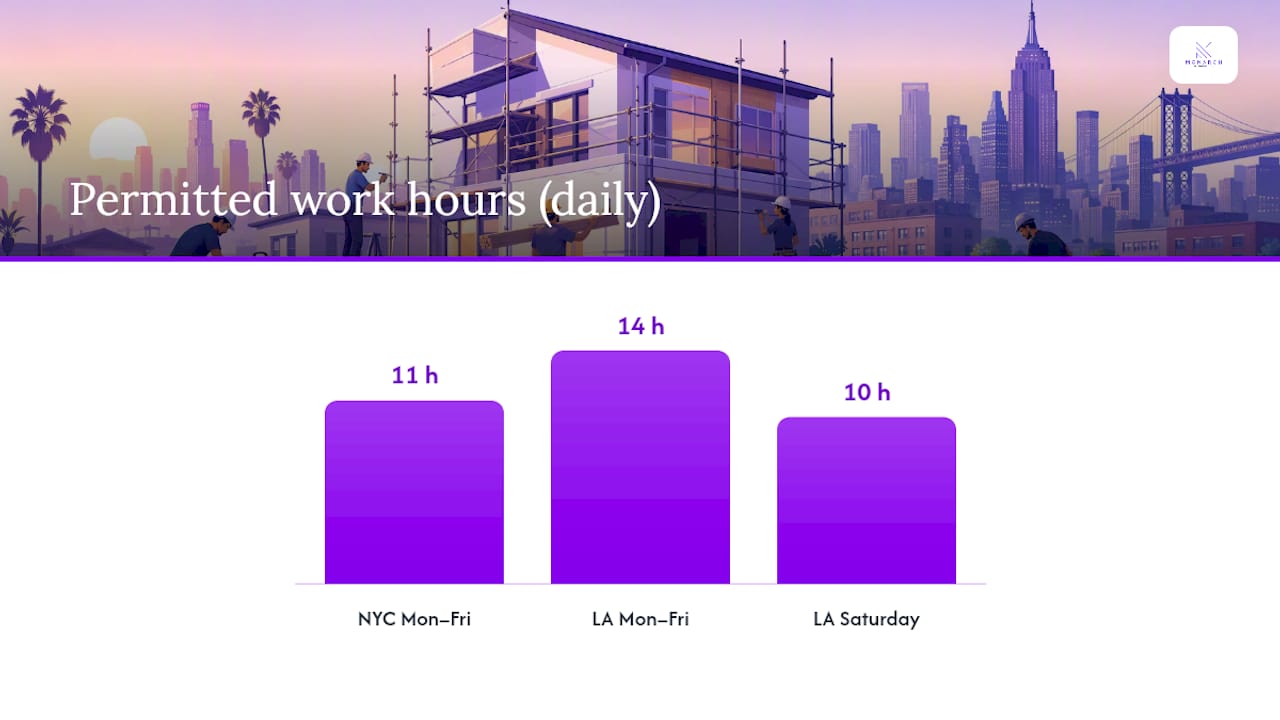
Smaller cities tend to run tighter. Daly City sets outdoor construction hours at 8:00 a.m. to 6:30 p.m. on weekdays (shifting to 8:30 p.m. during daylight saving time) and 9:00 a.m. to 6:30 p.m. on weekends, per its construction hours handout. Pensacola caps work at 6:00 a.m. to 7:00 p.m. Monday through Saturday and bans it entirely on Sundays, based on the city’s extended construction work permit guidance. Charleston restricts loud equipment to 7:00 a.m. to 7:00 p.m. on weekdays and 9:00 a.m. to 7:00 p.m. on Saturdays.
A few patterns explain the spread:
Larger metros with dense construction activity tend to allow longer weekday windows and offer a formal after-hours permit path.
Smaller jurisdictions often lean on stricter daytime-only limits, with permits meant for genuine emergencies rather than routine schedule flexibility.
Residential zones almost always face tighter restrictions than commercial or industrial zones, where extended or overnight work is more common.
Daylight saving time can push evening cutoffs later in cities like Daly City, so the same “6:30 p.m.” rule reads differently in July than in January.
Treat every range above as illustrative. The ordinance that governs your address, not a nationwide average, is what an inspector will cite.
Are Weekends and Holidays Off-Limits for Renovation?
Sunday work is the most common flashpoint. Pensacola bans construction entirely on Sundays, and Charleston forbids loud equipment on Sundays and certain holidays. Los Angeles generally prohibits Sunday construction too, treating it much like a holiday.
Federal holidays typically get the same treatment as Sundays under local codes, though the list of covered holidays varies by city. That said, most ordinances build in room for real emergencies:
Emergency repairs, like a burst pipe or storm damage, are usually exempt from time restrictions.
Utility work performed by a public agency often falls outside the standard construction hour rules.
Concrete pours and other time-sensitive tasks can sometimes get a short permit if the contractor gives proper notice, often through a flyer posted in the neighborhood listing work hours, dates, and a contact person, a requirement built into Pensacola’s permit process.
Extended or emergency permits are rarely open ended. Pensacola’s version is commonly capped around three days, which tells you these are meant for a specific disruption, not a workaround for a longer project.
How Do You Confirm Local Rules and Apply for an After-Hours Permit?
Guessing at your city’s construction hours is the single most common way homeowners end up with a stop-work order. Confirming the rule takes fifteen minutes; ignoring it can cost a project days.
Search your city’s building department or “construction noise” page first. NYC’s Department of Environmental Protection, LADBS, and Daly City all publish these online with hours and forms spelled out.
If your project needs to run outside the standard window, download the after-hours or extended-hours permit application, not a generic building permit.
Assemble the packet: a noise mitigation plan, a list of equipment you’ll use, exact dates and times requested, an on-site contact person, signed contractor notices, and the applicable fee.
Submit the application to the building or environmental department and wait for written approval before starting work outside normal hours.
Keep a copy of that approval on site at all times, along with the mitigation plan, since several municipal codes explicitly require it to be available for inspection.
Pro Tip: Call the building department directly even after reading the ordinance online. Municipal pages lag behind actual practice more often than you’d think, and a five-minute phone call can save you a fine over a rule that changed last year.
What Counts as Noisy Construction Work?
Not every renovation task trips the noise rules, and knowing the difference saves you from applying for permits you don’t actually need. Cities generally split activity into two buckets: heavy mechanical equipment and everything else.
Pile drivers, backhoes, pneumatic hammers, and similar heavy machinery almost always fall under the strictest hour restrictions.
Low-noise interior work, like painting, cabinetry installation, or hand-tool finishing, often escapes the same limits entirely.
Site staging is sometimes allowed before permitted hours begin. Daly City permits setup up to one hour before its official start time, as long as no equipment runs during that window.
Charleston’s ordinance draws a similar line, restricting “loud mechanical equipment” more tightly than general construction activity.
Your city’s code will define what it considers “loud,” so check that definition rather than assuming your project qualifies for the interior-work exception.
What Happens If You Violate Construction Hour Rules?
Most enforcement starts with a neighbor complaint, filed through a city’s 311 line or a direct code enforcement request, though Los Angeles also runs a dedicated violation reporting channel through LADBS. An inspector responds, checks the time against the posted permit, and looks for a mitigation plan on site.
Penalties escalate from there:
A first violation typically brings a fine.
Repeat violations can trigger a stop-work order, halting the entire project until it’s resolved.
Extended or emergency permits are short and time-limited by design, so working past the approved window counts as a new violation.
If you get cited, produce your written permit and mitigation plan immediately, contact the enforcement office the same day, and correct the issue before the next scheduled inspection.
How Do You Stay Compliant and Keep Neighbors Happy?
Complying with your city’s hours is the floor, not the whole strategy. Scheduling the loudest tasks, like demolition or framing, inside the earliest part of your permitted window and consolidating them into fewer days cuts down on the number of days neighbors notice anything at all.
Quieter methods matter more than most contractors admit. Temporary noise barriers, mufflers on generators and compressors, and sequencing work so mechanical equipment runs in short bursts rather than all day all follow the kind of administrative and engineering controls NIOSH recommends for reducing noise exposure on job sites.
Post your permit and mitigation plan somewhere visible on the property, not just in a filing cabinet.
Give neighbors a name and phone number to call if noise becomes a problem, rather than leaving them to guess who’s in charge.
Keep copies of every approval, notice, and flyer you distribute. This record is what protects you if a complaint turns into an inspection.
Pro Tip: A one-page flyer taped to your neighbors’ doors the week before a loud phase starts, listing dates, hours, and your contractor’s number, prevents more complaints than any noise barrier will. Coordinating that kind of notice is easier when you’re already working through a structured renovation project timeline with clear milestones.
A Short Checklist and the Mistakes Homeowners Keep Making
If you take one thing from this, it’s that confirming hours and getting a permit in writing beats any assumption about what’s “normal” in your area. The checklist is short: confirm your local hours, secure the right permit, prepare a mitigation plan, notify neighbors, and post the permit on site.
The mistakes are shorter still. People assume that because a neighbor tolerated noise once, it’s legal every time, and they skip saving written approvals until a complaint forces the issue. Skipping neighbor notice before a disruptive concrete pour is the fastest way to turn a quiet block against a project that was otherwise fully compliant.
— Seth Wayne
Where to Check Official Renovation Hour Rules
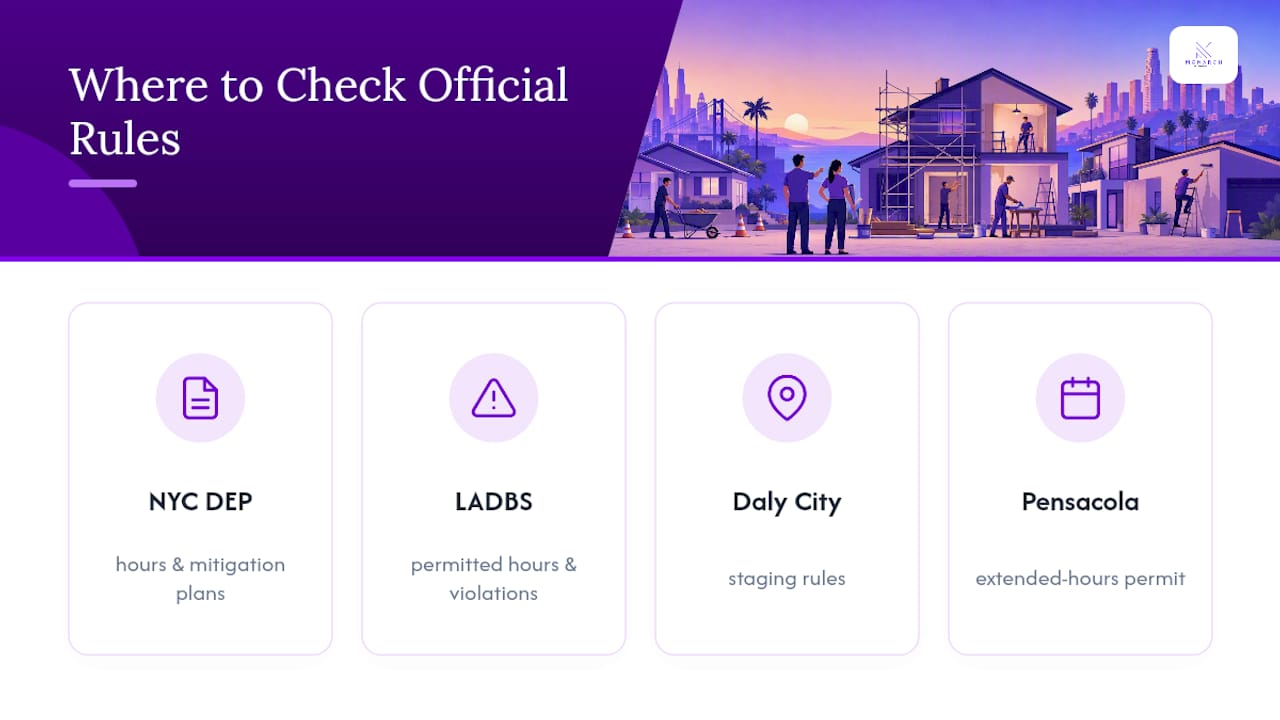
Confirm details directly at the source: NYC DEP’s construction noise page for hours and mitigation plans, LADBS for LA’s permitted hours and violation reporting, Daly City’s handout for staging rules, and Pensacola’s permit form for extended-hours applications.
Confirming your window is only half the job. Getting a renovation done well within it is where the right team matters, and this is exactly where working with a firm that understands both design and construction timelines pays off. Monarch carpenters is a design and carpentry studio based in Singapore known for its meticulous craftsmanship, blending contemporary design with the traditions of bespoke carpentry to build spaces that hold up over time. Their approach balances quality design with modest costs, earning them positive client feedback. If your renovation involves structural changes or additions, browsing a portfolio of completed facade and build work is a useful way to see how a collaborative design-build process comes together in practice. For homeowners weighing whether their project needs a full redesign or a more contained scope of work, Monarch’s consultation and design services are worth a conversation before you finalize your permit paperwork.
If your renovation is happening inside a condo or HOA building, the hour restrictions above often run alongside a separate layer of building-specific approval, covered in more detail in this guide to condo renovation rules and HOA approval. And if you’re still mapping out how long your project should realistically take once permitted hours are factored in, this breakdown of how renovation timelines actually work walks through the phases that tend to eat the most schedule time.
Sources
FAQ
Is Construction a 9-to-5 Job?
Not typically. Most cities permit work earlier than 9:00 a.m., often starting at 6:00 or 7:00 a.m., and many allow it to continue well past 5:00 p.m., with Los Angeles permitting weekday work until 9:00 p.m. The actual window depends entirely on your city’s ordinance.
What Time Is Construction Legally Allowed to Start in NYC?
New York City generally allows construction on private property starting at 7:00 a.m. on weekdays, running until 6:00 p.m., according to the NYC DEP. Work outside that window requires an after-hours authorization and an approved noise mitigation plan.
What Hours Do Contractors Usually Work?
Contractors generally schedule around the local permitted window, which commonly falls somewhere between 7:00 a.m. and 7:00 p.m. on weekdays. Weekend hours are usually shorter, and Sunday work is often restricted or banned outright depending on the city.
What Are the Official Construction Work Hours in the USA?
There is no single federal standard for construction or renovation hours. Cities set their own limits, ranging from Pensacola’s 6:00 a.m. to 7:00 p.m. window to LA’s 7:00 a.m. to 9:00 p.m. schedule, so the only accurate answer is whatever your local ordinance states.
Recommended
Comments