
Why Material Selection Matters for Your Renovation
- Monarch

- 11 minutes ago
- 11 min read

Material selection determines every measurable outcome in a renovation: how the finished space looks, how long it holds up, what it costs to maintain, whether it passes inspection, and what your family breathes every day. Standards like IECC and ASTM govern what can legally go into a home, and research shows that renovating an existing building can reduce embodied carbon by roughly 50–75% compared to demolishing and rebuilding — a figure that makes material strategy a financial and environmental decision, not just an aesthetic one.
Your next step: before you commit to any finish, request physical samples, check manufacturer warranties, and schedule a short material-review session with a designer or contractor. Those three actions alone prevent the most common and costly renovation regrets.
What material selection controls:
Appearance and design cohesion across rooms
Durability and expected service life (how many years before replacement)
Energy performance and operating costs
Indoor air quality through VOC emissions and moisture control
Code compliance and safety, including lead and asbestos risk in pre-1978 homes
Key Takeaways
Material selection in renovation determines appearance, durability, energy performance, indoor air quality, and code compliance — and the cost-per-year metric, not upfront price, is the most reliable way to compare options.
Point | Details |
Lifecycle cost beats upfront price | Divide total cost by service life years; the cheapest material often costs the most per year. |
Reuse before you replace | Extensive material reuse can reduce embodied impact by up to 50–64% vs. conventional strategies. |
Sustainability belongs at the start | Integrating sustainability criteria early reduces cost surprises and cascading changes later. |
Professionals prevent costly mistakes | Involve a designer and contractor before demolition to lock in specs and avoid late substitutions. |
Monarch carpenters | Offers bespoke design-build services with documented sample approval and modest-cost material strategies. |
Table of Contents
1. How material choices change your renovation outcomes
Choosing the correct material is central to achieving optimum lifecycle performance — covering durability, cost, and recyclability from day one. Here is what that looks like in practice across the outcomes homeowners care about most.
Appearance and design cohesion. Finish, texture, and undertone interact across a room in ways that are hard to predict from a small swatch. A warm-toned quartz countertop can make cool-gray cabinetry feel disconnected; a matte laminate floor can read as cheap next to high-gloss millwork even when the colors match. Resale appraisers consistently note that cohesive material palettes read as higher quality than individually expensive pieces that clash. Pulling samples together in the actual space, under the room’s own lighting, is the only reliable way to confirm cohesion before you order.
Durability and maintenance. Service life varies dramatically by material category. Solid hardwood flooring, properly finished, typically lasts 25–100 years with periodic refinishing. Luxury vinyl plank runs 10–25 years depending on wear-layer thickness. Ceramic tile in a wet area can last 20–50 years, but only if the substrate beneath it meets TCNA standards for deflection and moisture resistance. Cabinet boxes built from moisture-resistant MDF or plywood outlast particleboard by a decade or more in humid kitchens. Common failure modes worth knowing: laminate countertops delaminate at seams when water infiltrates; grout in improperly waterproofed showers cracks within two to three years; and paint-grade MDF trim swells at the base when it sits on a wet floor.

Energy and environmental impact. Insulation R-value, window U-factor, and cladding thermal mass all affect your monthly utility bill and your home’s carbon footprint. Sustainable material choices reduce energy use, maintenance needs, and indoor pollutant emissions when low-VOC and moisture-resistant products are selected. Targeting specific assemblies — attic insulation, rim joists, and drafty windows — typically delivers bigger performance gains than a wholesale cosmetic overhaul.
Indoor air quality and health. Many standard paints, adhesives, and composite wood products off-gas volatile organic compounds (VOCs) for months after installation. Low-VOC and zero-VOC alternatives are widely available at comparable price points and are worth specifying by name in your contract. In wet areas, the substrate choice matters as much as the tile: cement board or foam-core tile backer resists mold; standard drywall behind tile is a moisture trap that fails within a few years.
Code compliance and safety. Improper material substitutions are a leading cause of failed inspections. The IRC, IBC, IECC, ASTM, UL, and TCNA all set minimum performance thresholds that your contractor must meet. If your home was built before 1978, disturbing walls, floors, or ceilings without testing for lead paint or asbestos is a health and legal risk. Always have a certified inspector test suspect materials before demolition begins.
2. A practical checklist for choosing renovation materials
A structured approach to the importance of material choice prevents the expensive mid-project pivots that inflate budgets and delay timelines.
Step-by-step selection process:
Define your priorities: style, budget, durability, maintenance tolerance, sustainability goals, and how long you plan to stay in the home.
Inventory what can stay. The greenest material is often the one already in place; refinishing existing hardwood or repainting solid-wood cabinets costs far less than replacement and preserves embodied carbon.
Prioritize performance assemblies first: insulation, windows, and moisture barriers affect operating cost and structural integrity. Cosmetic finishes come after.
Gather physical samples and view them in the actual space under natural and artificial light.
Verify specs: ask for the manufacturer’s technical data sheet, the warranty document, and the installation tolerances.
Factor in labor complexity. Some materials (large-format porcelain slabs, for example) require specialized installers whose availability and cost can shift your budget significantly.
Document everything in the contract: model numbers, finish codes, acceptable color tolerances, and who pays for replacement if delivered product does not match approved samples.
Questions to ask your supplier or contractor:
What is the moisture-resistance rating, and is it appropriate for this application?
What are the installation tolerances, and what substrate preparation does this product require?
What does the warranty cover, and what voids it?
What is the lead time, and is there a backup SKU if this item is backordered?
How is this material repaired if a section is damaged — can it be spot-repaired or does the whole field need replacing?
A renovation mood board helps translate aesthetic decisions into specific material samples before you commit to any purchase order.
Pro Tip: Document approved samples with photos, model numbers, and finish codes in a single shared folder. Attach that folder reference to the contract clause that governs substitutions, so there is no ambiguity about what “approved” means if a product is swapped during procurement.
3. Using cost-per-year to compare your options
Upfront price is the least useful number when comparing renovation materials. A better metric is cost per year of service life, which combines purchase price, installation cost, expected lifespan, and maintenance cadence into a single comparable figure.
How to calculate it: Add the material cost and installation cost, then divide by the expected service life in years. Add an annual maintenance estimate. The result is a cost-per-year figure you can compare across options at the same level of function.
The table below uses illustrative figures to show the method. Populate it with real quotes from your contractor and vendor data sheets before making a final decision.
The low-cost option costs the most per year of service. That pattern holds across most material categories, which is why the importance of material choice extends well beyond the purchase order.
A life-cycle assessment found that limited material reuse reduced upfront embodied impact by roughly 9–28%, and extensive reuse by up to about 50–64% compared with conventional strategies. That range makes a strong case for auditing what you already have before ordering new.
A sustainability-informed selection framework like SIMS-D3 recommends ranking technical, environmental, and social criteria early — toxicity, circularity, supply risk — so tradeoffs are visible before costs are locked in.
Where to find authoritative data:
Environmental Product Declarations (EPDs) from manufacturer or third-party registries
DOE and EPA guidance on building materials for energy and health performance benchmarks
ASTM and TCNA standards for installation performance requirements
Manufacturer technical data sheets for warranty terms and installation tolerances
For a deeper look at green home renovation practices and how early material decisions reduce both embodied carbon and operating costs, Monarch carpenters has published a practical guide for homeowners.
4. When to bring a professional into material decisions
The right professional at the right project stage prevents the two most expensive renovation problems: materials that fail inspection and late-stage substitutions that cascade into budget overruns.
Who contributes what:
Interior designer: material cohesion, finish selection, sample coordination, and documentation of approved specifications
Architect: structural feasibility, code-triggering changes (load-bearing walls, egress, envelope modifications)
Licensed contractor: installation feasibility, labor cost, substrate assessment, and procurement logistics
Specialty trades (electrician, plumber, HVAC): systems that interact with material choices — electrical design and material choices intersect directly with renovation scope, and envelope material choices influence HVAC system sizing
When to consult each professional:
Pre-design: involve your designer and contractor before any demolition to assess what can stay and what must go.
Design development: finalize material specifications with your designer; get contractor input on installation complexity and lead times.
Procurement: confirm all materials are ordered, approved samples are on file, and substitution protocols are in the contract.
Pre-installation: walk the site with your contractor to confirm substrate conditions match what the material requires.
Inspection: have your contractor confirm code compliance for all specified materials before the inspector arrives.
Understanding the role of an interior designer in renovation clarifies exactly what a designer brings to material selection and how that investment pays off in cohesion and avoided rework.
Checklist for evaluating a designer or contractor’s material process:
Do they provide a material schedule with model numbers and finish codes?
Can they supply references from projects where materials were substituted and how they handled it?
Do they require client sign-off on physical samples before ordering?
How do they document and communicate substitutions if a specified product is unavailable?
Pro Tip: Schedule a focused 90-minute material review meeting with your design-build team before procurement begins. Bring physical samples, the material schedule, and your contract’s substitution clause. Decisions made in that meeting cost nothing to change; decisions made after installation can cost thousands.
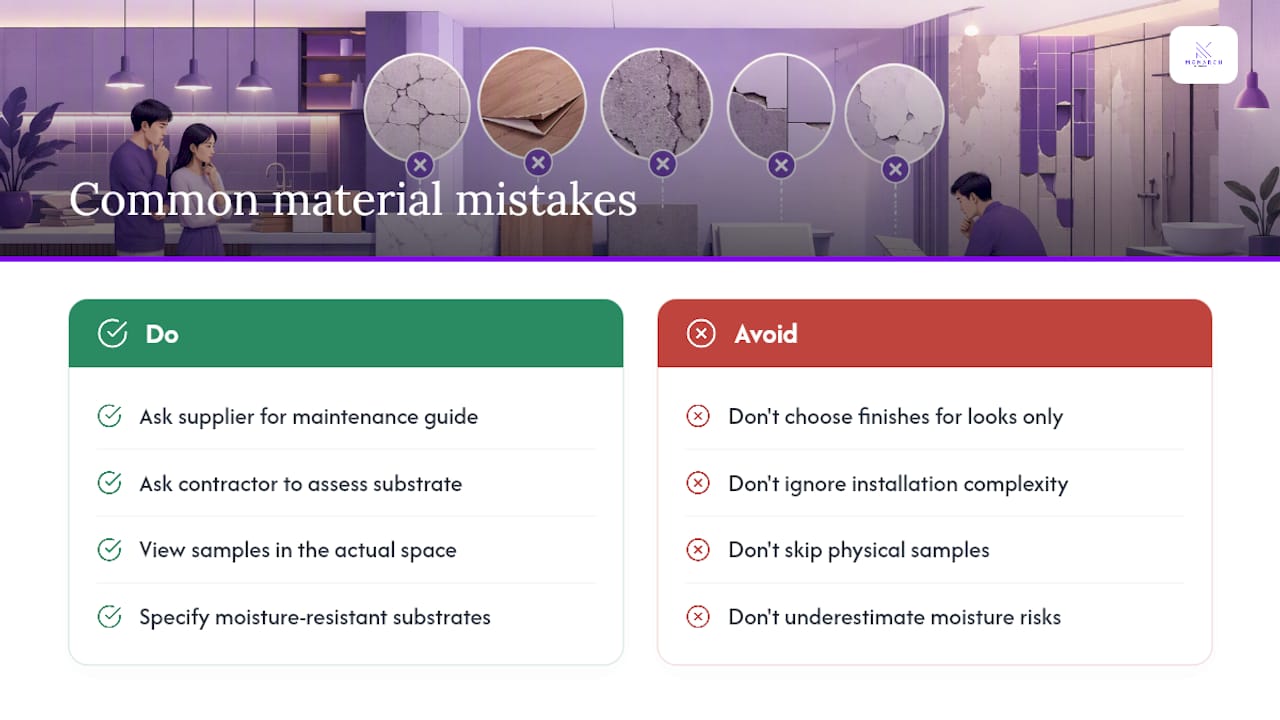
5. Common material-selection mistakes and how to avoid them
Most renovation regrets trace back to a small set of predictable mistakes. Knowing them in advance is the simplest form of protection.
Mistake 1: Choosing on looks alone. A homeowner selects a matte black faucet finish because it photographs well, then discovers it shows every water spot and requires daily wiping. Prevention: ask your supplier for a maintenance guide before you commit to any finish.
Mistake 2: Ignoring installation complexity. Large-format porcelain slabs require a flatter substrate and a more experienced installer than standard tile. Skipping that conversation leads to cracked tiles and a redo. Prevention: ask your contractor to assess substrate conditions and installer availability before specifying.
Mistake 3: Skipping physical samples. Digital renders and catalog photos are shot under controlled lighting. The same material in your kitchen under your lighting can look entirely different. Prevention: always view samples in the actual space before approving.
Mistake 4: Ignoring lifecycle cost. The renovation material benefits of a durable, slightly more expensive material almost always outweigh the savings of a cheaper one that needs replacement in eight years. Use the cost-per-year method from Section 3.
Mistake 5: Incompatible assemblies. Hardwood flooring installed over a radiant heat system without checking the manufacturer’s temperature tolerance will cup and gap within one heating season. Prevention: cross-reference the flooring spec with the subfloor and heating system specs before ordering.
Mistake 6: Underestimating moisture. Standard drywall behind a tiled shower, or laminate flooring in a basement without a vapor barrier, are among the most common and costly failures. Prevention: specify moisture-resistant substrates in every wet or below-grade application, and confirm with your contractor that the installation method matches the product’s requirements.
On warranties and contingency: Keep a 10–15% material contingency in your budget for finish upgrades discovered during demolition. Confirm return policies before ordering — many tile and flooring suppliers accept returns only on full, unopened boxes within a set window.
6. A studio perspective on modest-cost, high-value choices
The most common misconception we encounter at Monarch carpenters is that quality requires a large budget. It does not. It requires deliberate choices made at the right moment in the project.
Refinishing existing solid-wood cabinets, for example, typically costs a fraction of replacement and can deliver a result that looks and performs as well as new — sometimes better, because older solid-wood construction is often denser than what is available today. Repairing original windows with weatherstripping and reglazing, when the frames are structurally sound, preserves both embodied carbon and character that new units rarely replicate. These are not compromise decisions; they are the kind of choices that repair and selective reuse often deliver greater environmental and economic benefit than wholesale replacement.
Integrating sustainability into material selection early in the process reduces cost surprises later. At Monarch carpenters, we treat sustainability as a selection criterion from the first design conversation, not as an add-on at the end. That approach consistently produces spaces that clients describe as feeling considered and cohesive, at price points that reflect careful specification rather than expensive materials.
Our process includes documented sample approval, mockup sign-off for custom carpentry, and a clear substitution protocol in every contract. Clients receive a material schedule with model numbers and finish codes before any order is placed. That documentation is not bureaucracy; it is the mechanism that keeps modest budgets from expanding and keeps finished results matching what was agreed.
Monarch carpenters brings great design to modest budgets
Clients who work with Monarch carpenters consistently note the same thing: the finished space looks and performs far better than the budget suggested it would. That outcome is not accidental. It comes from a design-build process where in-house designers and carpenters collaborate from the first material conversation through final installation, keeping specifications tight and substitutions documented.

Monarch carpenters specializes in bespoke carpentry and interior design for residential, commercial, and hospitality spaces, with a track record of delivering cohesive, durable results at price points that reflect careful specification rather than expensive materials. Every project includes a material schedule, physical sample approval, and a substitution protocol, so what you approve is what gets built. The design and build process is structured to make material decisions at the right stage, before costs are locked in and changes become expensive.
If you are planning a renovation and want a focused material review with a team that has delivered high-quality results at modest cost, contact Monarch carpenters to schedule a consultation.
Sources
These resources support the claims in this article and give you authoritative data to work with as you finalize your material selections.
FAQ
Why does material selection matter in construction and renovation?
Material choices determine a project’s durability, energy performance, indoor air quality, and code compliance. Choosing the correct material is central to achieving optimum lifecycle performance, covering cost, longevity, and recyclability from the start.
How do I choose materials for a remodeling project?
Start by defining your priorities (style, budget, durability, sustainability), then inventory what can stay, prioritize performance assemblies like insulation and windows, gather physical samples, verify specs and warranties, and document all approvals in the contract before ordering.
What are the main factors that influence renovation material selection?
The four core factors are technical performance (strength, moisture resistance, service life), lifecycle cost (upfront price plus maintenance divided by years of use), environmental impact (embodied carbon, VOC emissions, recyclability), and code compliance with standards like the IRC, IECC, and ASTM.
Can reusing existing materials really reduce environmental impact?
Yes. A comparative life-cycle assessment found that extensive material reuse can reduce upfront embodied impact by up to 50–64% compared with conventional renovation strategies, making reuse one of the highest-value decisions a homeowner can make.
When should I involve a professional in material decisions?
Bring a designer and contractor in before demolition begins, during the design development phase when specifications are being finalized. Late-stage material changes are among the most common causes of budget overruns, and Monarch carpenters structures its design-build process specifically to prevent them.
Recommended
Comments