
What a Carpentry Works Cost Breakdown Actually Costs
- Monarch

- 2 days ago
- 7 min read

A clear, itemized carpentry works cost breakdown separates labor, materials, and allowances, so you can budget with confidence instead of guessing. Most homeowners see hourly rates between $40 and $200, with a national average closer to $60 to $70. Every trustworthy estimate splits into three parts:
Labor: crew hours multiplied by skill-based rates
Materials: timber, hardware, and finishes priced by unit
Allowances: waste factors and contingency for the unexpected
Look for unit pricing, a contingency percentage if stated, and detailed line-item totals. At Monarch carpenters, we build every quote this way, which is part of why our clients tell us they never feel blindsided by a final invoice.
Key Takeaways
A trustworthy carpentry works cost breakdown always separates labor, materials, and allowances into distinct, verifiable line items rather than one bundled number.
Point | Details |
Three core cost categories | Every estimate should separate labor, materials, and allowances or contingencies. |
Typical hourly range | Carpenters charge roughly $40 to $200 per hour depending on skill tier and region. |
Contingency matters | A 10% contingency line reduces defensive padding and unexpected change orders. |
Compare like-for-like | Confirm scope, unit pricing, and labor hours match before comparing two bids. |
Monarch’s approach | Monarch carpenters builds line-item bids that pair modest pricing with design-forward results. |
Table of Contents
What Is a Carpentry Works Cost Breakdown?
A carpentry works cost breakdown is an itemized estimate that separates labor hours, materials by unit, hardware, equipment, permits, waste allowance, and provisional sums, rather than bundling everything into one number. That distinction matters because a lump-sum quote hides where your money actually goes. A proper breakdown includes:
Labor hours and labor burden (insurance, payroll taxes, supervision)
Materials priced by board foot, linear foot, or item
Hardware, finishes, and consumables
Equipment, waste allowance, and provisional sums
Electrical, plumbing, and structural permit costs should appear as separate lines, never folded into carpentry pricing, since Houzz Pro’s estimating guidance treats overhead and profit as their own visible category too.
How Are Labor, Materials, and Allowances Calculated?
Labor is the largest variable. Rates shift by skill tier, from apprentice to journeyman to master carpenter, and by whether you’re billing a solo pro or a full crew. HomeAdvisor recommends setting aside 20% to 40% of your total budget for labor, depending on whether a general contractor is managing the job. A basic line item looks like: hours worked × hourly rate, plus labor burden for insurance and supervision.
Materials vary just as much. Softwood like pine costs far less than oak or walnut, and solid wood construction runs higher than veneer over particleboard. Ask for unit pricing, not a single “materials” line, so you can compare species, hardware brand, and finish level across bids. Our guide on material selection breaks down how these choices ripple through a renovation budget.
Allowances and contingencies cover the unknowns. Lumber waste typically runs 10% to 15% on cut-and-fit jobs, and a 10% contingency line is standard for unforeseen site conditions. Any change order should be documented in writing with its own cost impact, not absorbed silently into the original quote.
Equipment and disposal (rentals, travel, debris removal) should appear as their own line unless the contractor explicitly states they’re wrapped into labor.
Pro Tip: Ask the contractor to break labor into crew roles, master carpenter, journeyman, apprentice, and hours per role. A master carpenter billing a higher rate often finishes faster and with less rework, which can lower your total cost.
What Are Typical Carpentry Rates and Project Costs?
Rates vary by specialization and project type. Angi reports an average near $50 per hour, with a typical range of $40 to $100, while CurrentCost breaks estimates into labor, equipment, handling, and travel components that shift by region.
Specialization / Item | Typical Rate | Unit |
Framing carpenter | $40–$100 | per hour |
Trim and molding | $10–$15 | per linear foot |
Finish carpentry | $60–$100 | per hour |
Custom cabinetry | $70–$200 | per hour |
Master carpenter | $40–$200 | per hour |
Door installation | $150–$250 | per door |
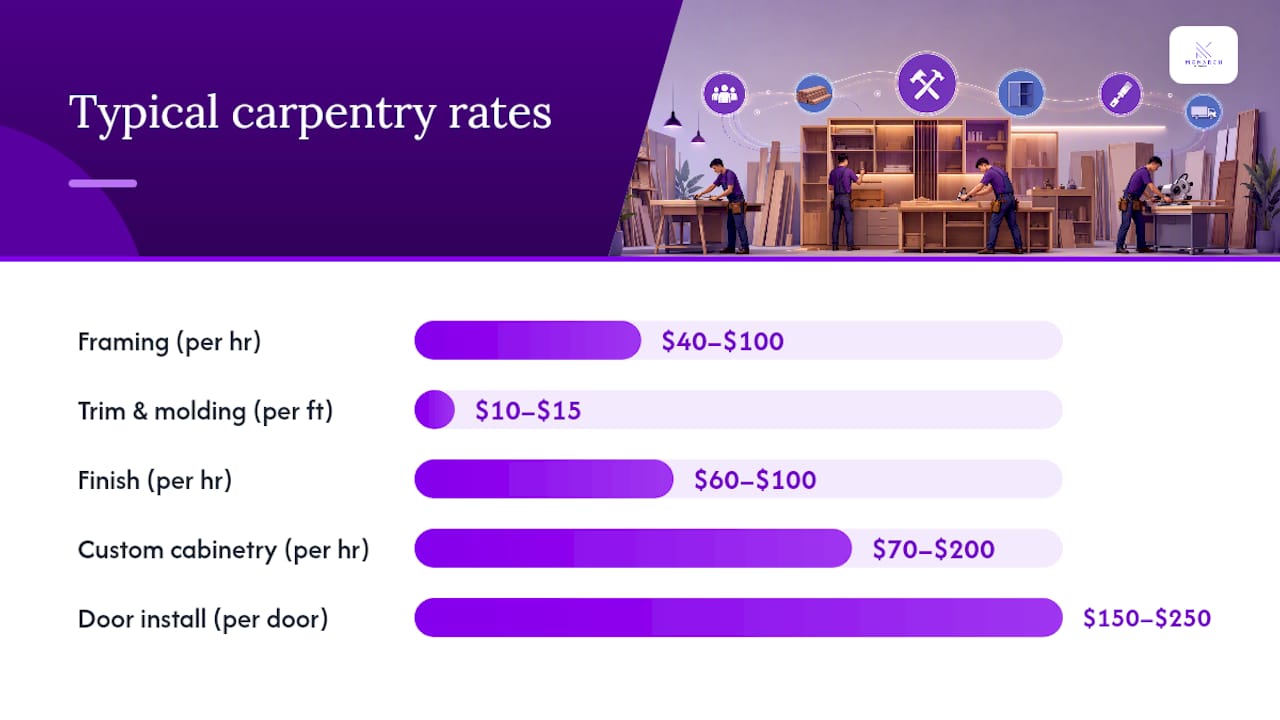
Common project ranges reflect how these rates stack up in practice. A basic closet build-out often lands in a lower to mid price range, while a full custom deck can cost significantly more depending on materials and footprint. Built-in shelving and custom furniture pieces show wide price variability based on joinery complexity and wood species. Jobs push toward the high end when access is tight, finishes are elaborate, or the design calls for hand-cut joinery instead of standard hardware.
Here’s a worked example for a built-in bookcase: 20 hours of labor at $85 per hour comes to $1,700. Materials (plywood, hardwood face frame, adjustable shelving hardware) run $900. That’s the kind of math a real estimate should show you, not hide.
How Do You Compare Two Carpentry Estimates?
Reading two quotes side by side only works if both cover the same scope. Run through this checklist before comparing numbers:
Confirm both estimates define identical scope and specifications
Check that labor hours are shown, not just a lump total
Verify materials are specified by grade, species, or spec sheet
Look for a stated contingency percentage
Review the payment schedule and warranty terms
Ask the contractor directly who supplies materials, how markups are applied, and what happens if a “sundries” line grows mid-project. Our comparison of design-build versus separate contractor models covers how procurement structure changes where these costs surface.
Watch for these red flags:
A lump-sum quote with zero line-item detail
No contingency line at all
Vague “sundries” or “miscellaneous” charges with no dollar breakdown
Unusually low labor rates with no mention of insurance or burden
What Drives Carpentry Costs Up or Down?
Joinery complexity, wood species, finish level, site accessibility, and project scale are the five levers that move your final number most. A hand-cut dovetail joint costs more than a pocket-screw connection. Oak costs more than pine. A third-floor walk-up with no elevator costs more than ground-level access.
You can control several of these:
Simplify finish choices (stain instead of multi-step lacquer)
Reuse existing cabinet carcasses where the structure is sound
Buy standard hardware sizes instead of custom-milled options
Consolidate work into fewer site visits to cut setup and travel fees
DIY or handyman work makes sense for simple shelving or basic repairs. Specialized joinery, structural built-ins, and anything touching load-bearing elements call for a trained carpenter, since rework from a botched DIY attempt almost always costs more than hiring right the first time.
Pro Tip: Insist on unit pricing for every door, hinge, and handle rather than one lump “hardware” line. This single request protects you from quiet substitutions to cheaper fittings.
Why Do Carpentry Quotes Vary So Much?
Labor availability explains much of the spread you’ll see between bids. The Associated General Contractors found that 80% of contractors report difficulty finding qualified craft workers, which pushes wages upward in tight markets. Contractors also build in “defensive pricing,” padding estimates against unknown site conditions they haven’t inspected closely. A clear contingency line, rather than a vague buffer baked into every number, is the fix. Wage trends tracked by FRED’s construction earnings series confirm this upward pressure isn’t temporary.
How Were These Reference Numbers Compiled?
The rates and ranges above draw from national wage data, industry cost guides, and contractor-facing estimating standards, including BLS occupational data and cost-component breakdowns from CurrentCost. Key assumptions:
Figures represent national averages, not local pricing
Material costs exclude local transport and delivery fees
A 10% contingency is the default unless a project specifies otherwise
Regional variation is real. Always request local unit pricing from a trade professional before finalizing your budget.
Why Line-Item Estimates Protect Homeowners
Producing line-item bids for years has taught us one lesson above all: transparency up front eliminates most disputes down the line. When labor, materials, and allowances are separated clearly, change orders shrink because there’s no ambiguity to argue over. It’s part of why Monarch carpenters has built a reputation for strong client reviews paired with modest, design-forward pricing.
Get a Detailed Carpentry Estimate From Monarch
Monarch carpenters is the alternative to guesswork pricing: our in-house design and carpentry team delivers line-item bids that separate labor, materials, and allowances before a single cut is made, so you know exactly where your budget goes.

We handle design, custom carpentry, and project management under one roof, which means fewer handoffs, fewer surprise markups, and a single point of accountability from concept to installation. Our clients consistently point to two things: the quality of the design work and how reasonable the final invoice looks next to the original quote. If you’re weighing custom cabinetry, a built-in feature, or a full room renovation, browse our kitchen cabinet customization guide for a sense of how we scope real projects. Ready to see numbers specific to your space? Request a detailed estimate from Monarch carpenters and get a line-item breakdown built around your actual scope, not a generic average.
Sources
FAQ
What do most carpenters charge per hour?
Most carpenters charge between $40 and $200 per hour, with a national average closer to $60 to $70 depending on specialization and region.
Can a carpenter make $100,000 a year?
Experienced carpenters, especially master carpenters or those running their own crews, can reach six-figure income in high-cost markets or specialized fields like custom cabinetry, according to wage data tracked by the Bureau of Labor Statistics.
What are the 5 levels of cost estimation?
Cost estimating generally moves through stages of increasing detail, from rough order-of-magnitude figures to a final, itemized estimate with confirmed unit prices; definitions of the exact five levels vary by industry and estimator.
What is the cost per square foot for framing a 20x20 building, labor only?
Framing labor typically runs in the range of a few dollars per square foot, though the exact figure depends heavily on region, crew size, and site accessibility, so always request a local labor-only quote for an accurate number.
How does Monarch carpenters structure its estimates?
Monarch carpenters separates labor, materials, and allowances into clear line items on every quote, which is designed to reduce disputes and give homeowners a budget they can verify before work begins.
Recommended
Comments