
Flooring Selection for Singapore Renovations: A Room-by-Room Guide

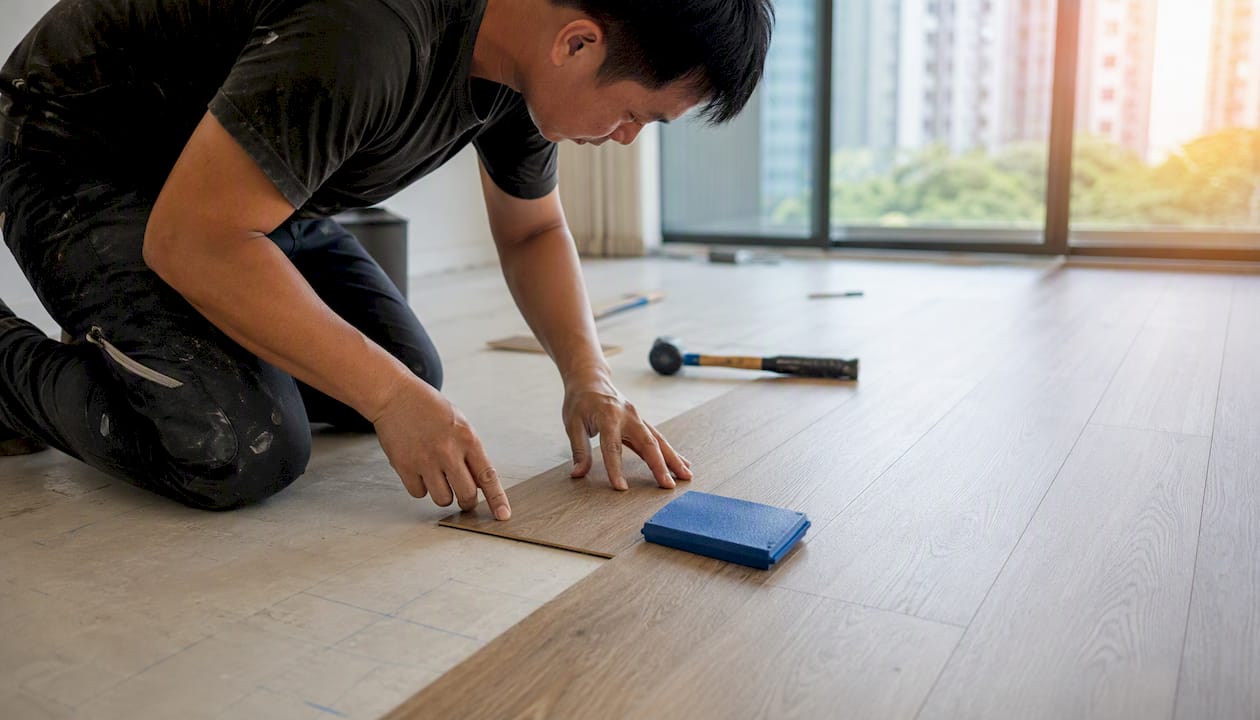
For most Singapore homes, the short answer on flooring selection for your renovation is this: use vinyl SPC or LVT in living rooms, bedrooms, and kitchens; porcelain tile in bathrooms and wet areas; and engineered wood where you want warmth and are willing to manage humidity carefully. Balconies and utility areas call for outdoor-rated porcelain or anti-slip ceramic. This shortlist is grounded in Singapore’s tropical climate, where year-round humidity is typically high, and in HDB’s 50mm total finish-thickness rule that limits how much you can layer underfoot. Monarch Carpentry Design Studio helps homeowners work through these constraints with in-house designers and carpenters who stage samples on-site before a single plank is ordered.
Living room: SPC vinyl or engineered wood. Both handle humidity well; SPC overlays avoid hacking costs entirely.
Bedrooms: SPC/LVT or engineered wood. Comfort underfoot and acoustic performance matter here.
Kitchen: Porcelain tile or SPC vinyl. Waterproof and easy to clean; avoid laminate near cooking moisture.
Bathrooms: Porcelain tile with an R10+ slip-resistance rating. Waterproof membrane underneath is non-negotiable.
Balcony/entry: Outdoor-rated porcelain or anti-slip ceramic. UV and rain exposure rule out most wood products.
Utility/yard: Unglazed ceramic or quarry tile. Durability and drainage over aesthetics.
Before buying anything, order physical samples and live with them for 48 hours under your home’s actual lighting and foot traffic. A FloorScore-certified product confirms low VOC emissions, which matters in Singapore’s sealed, air-conditioned interiors.
Key Takeaways
For Singapore renovations, SPC/LVT vinyl is the most practical flooring choice for most rooms, porcelain tile is the only sensible option for wet areas, and every installation should begin with a moisture test and a written method statement from your contractor.
Point | Details |
Match material to moisture risk | Use SPC/LVT or porcelain tile in wet and humid zones; keep engineered wood and laminate away from kitchens and bathrooms. |
Respect HDB’s 50mm rule | Total finish thickness including underlay cannot exceed 50mm above existing screed; check before specifying overlay on existing tiles. |
Order samples and test in-situ | Place shortlisted samples in your actual room for 48 hours under real lighting before purchasing. |
Budget for 10-year ownership cost | Include installation, underlay, maintenance, and likely replacement cycles, not just material price per sqft. |
Monarch carpenters | Provides site measure, sample staging, written method statements, and in-house installation with a workmanship warranty for Singapore homes. |
Table of Contents
What are the best flooring types for Singapore renovations?
Every material behaves differently once Singapore’s humidity gets into the equation. Here is what you need to know about each option before committing.
Luxury vinyl (LVT/SPC). Stone Plastic Composite (SPC) and Luxury Vinyl Tile (LVT) are the dominant choices for Singapore HDB flats right now, and for good reason. SPC is stiffer and denser than standard LVT, making it better for rooms with heavy furniture. Both can be installed as a floating overlay directly over existing cement screed, which avoids the cost and noise of hacking. LN Flooring’s 2026 HDB guide recommends vinyl as the default choice for most HDB rooms precisely because of this waterproof, overlay-compatible profile.
Engineered wood. A real wood veneer bonded to a plywood or HDF core, engineered timber delivers the warmth and grain of hardwood with meaningfully better dimensional stability in humid conditions. It is not waterproof, but it handles Singapore’s humidity far better than solid hardwood. Keep it out of bathrooms and kitchens. Goodrich Global’s flooring comparison notes that engineered wood is the preferred timber option for tropical climates precisely because the layered construction resists expansion.
Solid hardwood. Beautiful, but genuinely difficult to maintain in Singapore’s climate. Solid timber expands and contracts with humidity swings, leading to gapping in dry spells and cupping when moisture rises. Most contractors will advise against it for non-air-conditioned spaces. Treat it as a premium choice only for fully climate-controlled rooms.
Laminate. HDF-core laminate is the option most homeowners regret in Singapore. The core swells when moisture penetrates the seams, and in a tropical climate that is not a question of if but when. LN Flooring’s guide is direct: laminate is generally unsuitable for Singapore’s climate. The photographic surface layer also cannot be refinished.
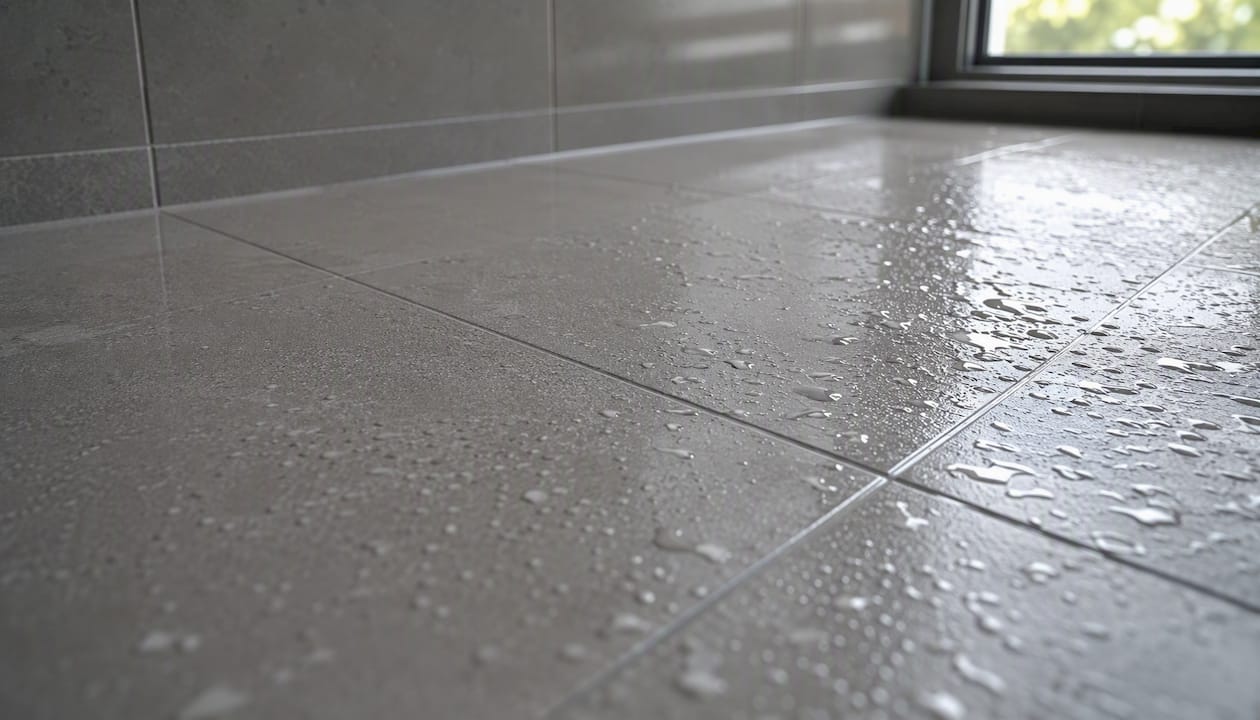
Ceramic and porcelain tile. Porcelain is denser, less porous, and more durable than standard ceramic, making it the right call for bathrooms, kitchens, and balconies. For wet areas, look for an R10 or higher slip-resistance rating. Tiles are permanent, hard underfoot, and cold to the touch, but they are essentially maintenance-free and last decades. Grout lines require periodic sealing to prevent staining and mold.
Natural stone. Marble, granite, and slate bring genuine luxury but demand ongoing maintenance. Natural stone is porous and needs sealing every one to two years; unsealed stone in a humid Singapore bathroom will stain and grow mold. Cost is high, and installation requires a skilled setter to avoid lippage.
Polished concrete. A growing choice for industrial-modern interiors. Polished concrete is durable and easy to clean, but it is cold, hard, and acoustically live. It also requires a skilled contractor to achieve a consistent finish and a penetrating sealer to resist staining.
Carpet and carpet tiles. Rarely specified in Singapore homes due to mold and dust-mite risk in high humidity. Carpet tiles work better than broadloom because individual tiles can be replaced. Suitable for home offices or bedrooms with consistent air conditioning, but not recommended for open-plan or non-air-conditioned spaces.
Material comparison at a glance
Material | Water resistance | Durability | Comfort underfoot | Expected lifespan |
SPC/LVT vinyl | Excellent | High | Good (with underlay) | 20–25 years |
Engineered wood | Moderate | Medium-high | Excellent | 20–25 years |
Solid hardwood | Poor | High (if maintained) | Excellent | 25+ years (climate-controlled only) |
Laminate (HDF) | Poor | Medium | Good | 5–10 years (Singapore climate) |
Porcelain tile | Excellent | Very high | Low (hard, cold) | 30 years |
Natural stone | Low (unsealed) | High | Medium | 20+ years (with maintenance) |
Polished concrete | Good (sealed) | Very high | Low | 20+ years |
Carpet/carpet tiles | Poor | Low | Excellent | 5–10 years |
Consumer Reports’ flooring buying guide recommends checking wear-layer thickness, underlayment compatibility, and VOC certifications before purchasing any product, regardless of material category.
How do you pick the right flooring for each room?
A structured decision process prevents the most common and expensive mistakes. Work through these steps before requesting a single quote.
Step-by-step selection checklist
Define the room’s function and moisture risk. Wet areas (bathrooms, kitchens near sinks) require waterproof materials. Dry living and bedroom zones have more options.
Check your HDB or condo’s thickness limit. HDB’s 50mm total finish-thickness rule, documented by Home Expo Asia, means your new floor plus any underlay cannot exceed 50mm above the existing screed. This rules out thick stone tiles over existing tiles without hacking first.
Assess the existing subfloor. BTO flats receive raw cement screed in dry areas and ceramic tile in wet areas, as noted in Goodrich Global’s BTO flooring guide. Overlay options work well over flat screed; uneven or cracked screed needs self-leveling compound first.
Factor in household specifics. Pets with claws favor SPC over engineered wood. Young children benefit from the softer feel of vinyl with a quality IXPE underlay. Home offices need acoustic performance.
Set a realistic budget, including installation. Material cost is only part of the number. Hacking, screed, self-leveling, waterproofing, and door trimming add up quickly.
Shortlist two to three materials and order samples. Place them in the actual room for 48 hours, at different times of day and near windows, before deciding.
Questions to ask your supplier or contractor
What is the wear-layer thickness in mm, and does the product carry FloorScore or equivalent VOC certification?
Is the product rated for overlay installation, or does it require a bonded screed?
What expansion gap do you leave at perimeters, and how are transitions handled at doorways?
What is the warranty period, and does it cover moisture-related failure?
Will you provide a written method statement before work begins?
Red flags to watch for
A contractor who skips a moisture test on the screed before laying engineered wood or SPC.
Laminate being quoted for kitchens or non-air-conditioned spaces.
No mention of expansion gaps or acoustic underlay in the proposal.
A verbal-only quote with no written scope of work.
Pro Tip: Place your shortlisted samples near the room’s main window and under your primary light fixture. Flooring colors shift dramatically between natural and artificial light, and a sample that looks warm in the showroom can read cold and gray at home.
Coordinating floor color with your wall palette is easier when you work through it systematically. Monarch carpenters’ guide on interior color scheme tips walks through that process for Singapore homes.
What does flooring cost in Singapore, and how long does it take?
Cost varies significantly by material, installation method, and whether hacking is involved. The figures below reflect typical Singapore market ranges.
SPC/LVT vinyl overlay: SGD 3–6 per sqft for material; installation adds SGD 1.50–3 per sqft. A 4-room HDB flat (roughly 900 sqft of floor area) typically runs SGD 4,000–8,000 all-in for vinyl overlay.
Engineered wood overlay: SGD 5–10 per sqft for material; installation SGD 2–4 per sqft. Expect typically several thousand Singapore dollars for a full 4-room flat.
Porcelain tile (hacking and relay): tile material and installation costs are significant, with additional charges for hacking and screeding. Bathroom retiling costs vary by size and tile specification.
Natural stone: SGD 10–25+ per sqft for material alone; installation and sealing add substantially to that figure.
Everyday Renovations’ 2026 renovation cost guide confirms that flooring selection materially affects total renovation budgets for 700–1,000 sqft units, where mid-range renovations can span a wide cost band depending on material choices.
Typical installation timelines
Scenario | Preparation | Installation | Total (working days) |
SPC/LVT overlay, 4-room HDB | 1 day (self-leveling if needed) | 1–2 days | 2–3 days |
Engineered wood overlay, 4-room HDB | 1 day | 2–3 days | 3–4 days |
Porcelain tile (hack and relay), bathroom | 1 day hacking + 1 day screed cure | 1–2 days tiling | 4–6 days |
Full flat tile hack and relay | 2–3 days hacking | 3–5 days tiling | 7–10 days |
Pro Tip: Compare 10-year total cost of ownership, not just upfront price. A SGD 4 per sqft SPC floor that lasts 20 years with zero maintenance often costs less over a decade than a SGD 3 per sqft laminate that needs replacing in five years due to moisture damage.
Extra costs that often surprise homeowners: self-leveling compound (SGD 1–2 per sqft), door trimming after floor height changes, acoustic underlay (SGD 0.50–1.50 per sqft), and HDB permit or neighbor coordination fees when hacking is required. For kitchen-specific sequencing, Monarch carpenters’ kitchen renovation checklist covers how flooring fits into the broader trade sequence.
What do contractors need to do before laying your floor?
Good installation starts well before the first plank goes down. These are the technical checks that separate a floor that lasts 20 years from one that pops, buckles, or squeaks within 18 months.
Moisture test the screed. A calcium chloride or relative-humidity probe test on the existing screed is non-negotiable before laying engineered wood or SPC. Moisture readings above the manufacturer’s threshold require a moisture-barrier primer or membrane.
Check flatness. Most floating floor systems require the subfloor to be flat within 3mm over a 1.8m span. Variations beyond that need self-leveling compound before installation begins.
Respect the 50mm thickness rule. Home Expo Asia’s guide documents HDB’s 50mm total finish-thickness limit. Stacking new flooring over existing tiles without hacking can breach this limit and create a trip hazard at doorways.
Waterproofing in wet areas. Bathrooms and wet kitchens require a cementitious or polyurethane waterproof membrane applied to the screed and up the walls at least 300mm before any tile is set. No membrane means moisture migrates into the slab and neighboring units.
Acoustic underlay selection. For condo and HDB units, acoustic performance matters to neighbors below. IXPE foam, cork, and rubber underlays each offer different impact-sound reduction values. Floorings.com.sg’s BTO guide recommends asking contractors for STC and IIC target values when specifying underlay for HDB Plus and Prime units.
Acclimatization. Engineered wood and some SPC products should sit in the installation room for 24–48 hours before laying, allowing the material to reach the room’s ambient temperature and humidity.
Expansion gaps. A 3–5mm perimeter gap around all walls, columns, and fixed objects is standard for floating floors. Skipping this gap is the single most common cause of buckling in Singapore’s humidity.
Contractor checklist before signing
Written method statement covering moisture test results, flatness check, and installation sequence.
Confirmation of expansion-gap practice and transition-strip specification.
Removal and disposal plan for hacked material (HDB requires licensed disposal).
Neighbor notification plan if hacking is involved.
Written workmanship warranty naming the wear-layer specification and installation scope.
Pro Tip: Ask your contractor to photograph the screed moisture readings and flatness checks before installation. These photos protect both parties if a warranty claim arises later.
How do you maintain different flooring types in Singapore?
Maintenance requirements vary more than most homeowners expect, and the right routine extends floor life significantly.
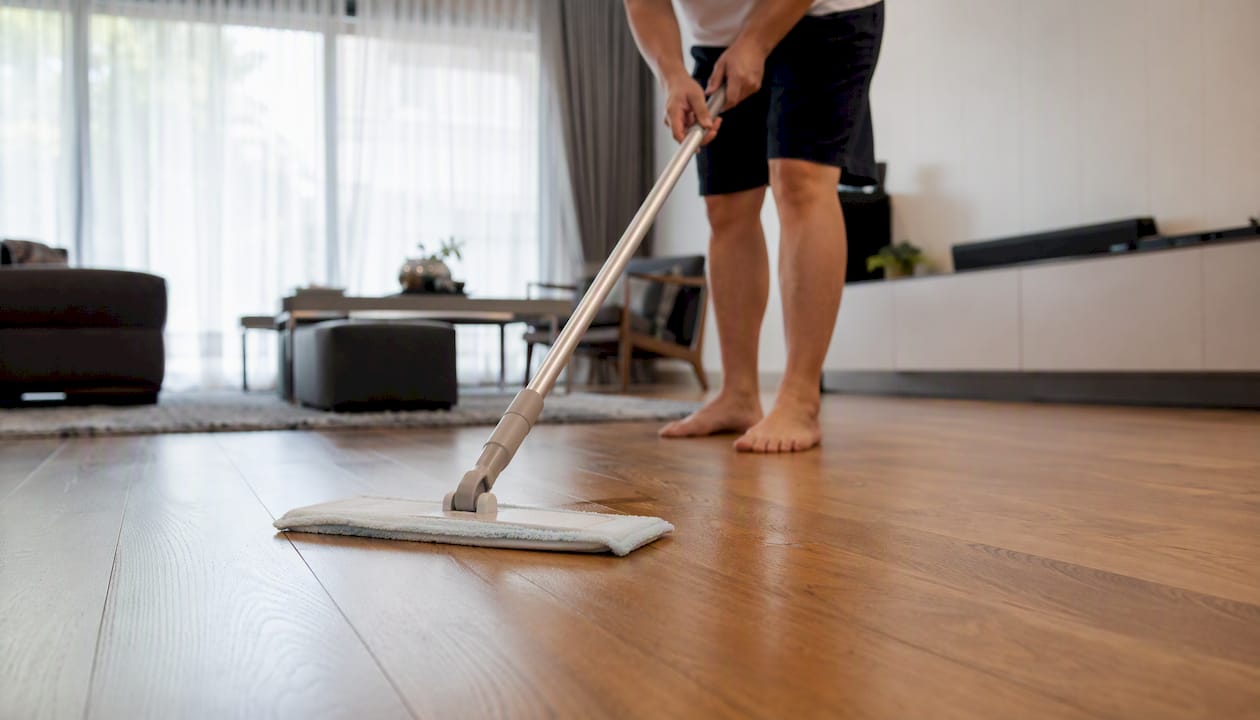
SPC/LVT vinyl: Sweep or vacuum daily to remove grit that scratches the wear layer. Damp-mop weekly with a pH-neutral cleaner; avoid steam mops, which can delaminate the wear layer over time. No sealing or refinishing required. Check wear-layer thickness on the product label: 0.3mm (12 mil) suits residential use; 0.5mm (20 mil) is better for high-traffic areas.
Engineered wood: Sweep daily and damp-mop sparingly with a wood-specific cleaner. Standing water is the enemy. Most engineered floors can be lightly sanded and refinished once or twice over their lifespan, depending on veneer thickness. AC ratings on laminate (AC3 for residential, AC4 for heavy residential) give a quick durability signal; engineered wood uses veneer thickness as the equivalent indicator.
Porcelain tile: Sweep and mop with a neutral cleaner. Grout lines need sealing every 12–18 months in Singapore’s humidity to prevent mold and staining. Use a penetrating grout sealer rather than a surface coat.
Natural stone: Seal every 12 months with a stone-specific penetrating sealer. Clean spills immediately; acidic liquids (citrus, vinegar) etch polished marble. Avoid abrasive cleaners.
Polished concrete: Reseal with a penetrating concrete sealer every 2–3 years. Sweep and mop with a neutral cleaner. Avoid dragging heavy furniture.
Seasonal maintenance for Singapore’s climate:
After the northeast monsoon season (November to January), inspect grout lines and sealant joints for cracking or mold growth.
After extended dry spells, check skirting boards and door clearances for any movement in floating floors.
Keep a record of your product batch numbers, installation photos, and contractor invoice. These are required for most warranty claims.
What mistakes do Singapore homeowners most often make with flooring?
These errors come up repeatedly, and each one is avoidable with a little preparation.
Choosing laminate for humid or non-air-conditioned rooms. HDF-core laminate swells when moisture enters the seams. In Singapore’s climate, this is a near-certainty in kitchens, bathrooms, and any room without consistent air conditioning. The consequence: bubbling, peaking seams, and a floor that needs full replacement within a few years.
Ignoring acoustic underlay requirements. Condo and HDB residents below you will hear impact noise from a hard floor with no underlay. Skipping acoustic underlay to save SGD 0.50–1.50 per sqft is a false economy that can lead to neighbor complaints and, in some condos, management notices.
Under-ordering materials. Ordering exactly the measured area without a 7–10% waste allowance for cuts, pattern matching, and future repairs is a common mistake. Dye lots change between production runs, so replacement tiles or planks ordered later may not match.
Skipping in-situ sample testing. A sample that looks right in a showroom under halogen lighting can read completely differently in your home. Consumer Reports identifies in-situ sample testing as one of the most reliable ways to prevent costly color regret after installation.
Choosing tile-on-tile overlay without checking thickness. Laying new tiles over existing ones without hacking can breach HDB’s 50mm finish-thickness limit and create uneven transitions at doorways.
No written scope from the contractor. A verbal quote with no method statement leaves you with no recourse if the installer skips moisture testing, expansion gaps, or acoustic underlay.
How Monarch carpenters helps you choose and install the right floor
Monarch carpenters’ process is built around one principle: the right floor for your home is not the most expensive option or the trendiest one. It is the one that performs in your specific rooms, fits your budget, and holds up to your household’s actual life.
The process works like this:
Site measure and subfloor assessment. Monarch’s in-house team visits your home, measures each room, checks screed flatness and moisture levels, and identifies any HDB/condo constraints before any material is discussed.
Material short-listing and sample staging. Based on the site findings, Monarch’s designers short-list two to three materials per room and stage physical samples in your home so you can evaluate them under your actual lighting and traffic conditions.
Written proposal with method statement and timeline. Every Monarch proposal includes a written installation method statement, a project timeline, and a line-item cost breakdown. No surprises.
In-house installation by Monarch’s carpentry team. Because Monarch’s designers and carpenters work under one roof, there is no coordination gap between what was specified and what gets installed. This reduces scope overlap and change orders, as the studio’s design-build model keeps both disciplines accountable to the same outcome.
Post-install walkthrough and warranty handover. Monarch conducts a final walkthrough with the homeowner, documents the installation with photos, and hands over a written workmanship warranty that names the wear-layer specification and installation scope.
Homeowners who have worked with Monarch consistently highlight two things: the quality of the design outcomes and the modest cost at which those outcomes are delivered. The studio’s collaborative approach, where designers and carpenters share the same brief from day one, removes the rework and miscommunication that inflate costs on projects managed across separate trades.
For HDB-specific constraints, Monarch handles thickness compliance, acoustic underlay specification, and neighbor coordination when hacking is required. Typical workmanship warranties cover installation quality for the period stated in the written proposal. To request a flooring consultation or an on-site measure, visit Monarch carpenters.
If you are planning a full-flat renovation where flooring intersects with joinery, lighting, and space planning, Monarch carpenters’ guide on what full home renovation involves is a useful starting point for understanding how the trades sequence together.
Are there sustainable flooring options worth considering?
Environmental performance is increasingly part of the flooring conversation in Singapore, and several materials have meaningful sustainability credentials.
FSC-certified engineered wood carries Forest Stewardship Council certification, confirming the timber veneer was sourced from responsibly managed forests. Look for the FSC logo on product documentation, not just the showroom display.
FloorScore certification applies primarily to hard-surface flooring (vinyl, laminate, tile) and confirms that the product meets indoor air quality standards for VOC emissions. In Singapore’s sealed, air-conditioned interiors, low-VOC flooring is a genuine health consideration, not just a marketing claim.
SPC/LVT vinyl presents a mixed sustainability picture. Some manufacturers now offer take-back programs for end-of-life vinyl.
Polished concrete is arguably the most sustainable option for new builds or major renovations because it uses the existing structural slab as the finished floor, eliminating the need for a separate flooring material entirely. No additional raw materials, no adhesives, no underlays.
Bamboo flooring is sometimes marketed as an eco-friendly alternative to hardwood. Bamboo grows rapidly and sequesters carbon, but many bamboo floor products use formaldehyde-based adhesives in their manufacturing process. Check for E0 or E1 formaldehyde emission ratings and FloorScore certification before specifying bamboo.
Carpet tiles made from recycled content (post-consumer PET fiber) are available and represent a more sustainable carpet option, though the humidity limitations in Singapore still apply.
The most sustainable choice is often the one that lasts longest with the least maintenance, which in Singapore’s climate points back to porcelain tile and SPC vinyl as the practical leaders.
The real trade-off most homeowners miss
Most flooring guides treat durability and aesthetics as competing priorities, as if you must sacrifice one to get the other. After working through hundreds of Singapore renovation projects, the Monarch carpenters team has found that the real trade-off is almost never beauty versus performance. It is almost always short-term cost versus long-term cost.
The homeowner who chooses laminate to save SGD 1–2 per sqft over SPC vinyl is not making a budget decision. They are making a replacement decision, because in Singapore’s climate, that laminate will likely need replacing within five to eight years. The homeowner who invests in a 0.5mm wear-layer SPC with a quality IXPE underlay gets a floor that feels better, sounds quieter, and lasts twice as long. The math is not close.
What we find equally important is that the right floor does not have to be expensive to be beautiful. Some of the most striking interiors Monarch carpenters has delivered used mid-range SPC vinyl in a wide-plank format, paired with thoughtful joinery and a considered color palette. The floor itself was modest in cost. The outcome was not.
The consultation process matters precisely because these trade-offs are specific to your home, your rooms, and your household. A designer who has staged samples in your actual space, under your actual light, is giving you information that no showroom visit can replicate.
Monarch carpenters makes your flooring renovation straightforward
Choosing the right floor for a Singapore home involves more variables than most homeowners anticipate: HDB thickness rules, acoustic requirements, moisture testing, and the gap between how a sample looks in a showroom and how it performs in your home. Monarch carpenters handles all of it, from the first site measure through to the post-install warranty handover, with an in-house team of designers and carpenters who have delivered cost-effective, beautifully finished spaces across Singapore’s residential and commercial sectors.

Client feedback consistently points to two strengths: design quality that punches above its price point, and a collaborative process that keeps projects on time and on budget. Monarch’s sample-staging service means you see your shortlisted materials in your own home before committing, and the written method statement means there are no surprises on installation day. To book a free site measure or request a costed flooring proposal, visit Monarch Carpentry Design Studio and submit a consultation request.
Sources
FAQ
What type of flooring is best for Singapore homes?
SPC or LVT vinyl is the most practical choice for most rooms in Singapore because it is fully waterproof, humidity-resistant, and can be installed as an overlay without hacking. Porcelain tile is the correct choice for bathrooms and wet areas.
What are the best flooring options for a Singapore renovation?
SPC/LVT vinyl suits living rooms, bedrooms, and kitchens; porcelain tile is right for bathrooms and balconies; engineered wood works in climate-controlled living and bedroom zones where a timber aesthetic is a priority.
How much does it cost to renovate flooring in a Singapore condo or HDB flat?
A full-flat SPC vinyl overlay for a 4-room HDB flat typically runs SGD 4,000–8,000 all-in; engineered wood overlay for the same flat typically costs several thousand Singapore dollars in total. Tile hacking and relay adds hacking and screed costs on top of material and installation. Everyday Renovations’ cost guide provides broader renovation cost bands for 700–1,000 sqft units.
How much does it cost to replace bathroom floors in Singapore?
Bathroom retiling costs depend on tile specification, room size, and whether hacking is required. Porcelain tile material and installation costs can be substantial, with additional costs for hacking and screeding; bathroom retiling costs vary depending on scope and tile choice.
Can Monarch carpenters help with flooring selection and installation?
Yes. Monarch carpenters provides site measurement, sample staging in your home, written method statements, and in-house installation with a workmanship warranty. Contact the studio at Monarchcarpenters to request a free site measure or a costed flooring proposal.
Recommended
Comments