
Drawer Runner Types for Bespoke Joinery: Avoid the 1/2 Inch Trap


Choose undermount slides for concealed, high-end cabinetry where appearance matters most, side-mount for retrofit projects and heavier loads, and center-mount only for light-duty, small drawers. Mechanism-wise, roller slides suit budget work, ball-bearing slides handle full extension and real weight, and soft-close or push-to-open features add convenience wherever hands are full. The deciding factors are always the same three: how much the drawer will carry, how far it needs to open, and how much of the hardware you’re willing to see.
TL;DR:
Side-mount slides are the most affordable and easiest to install but require precise side clearance, making them suitable for non-framed or spacious openings.
Undermount slides provide a concealed, furniture-grade look ideal for premium kitchens, but they demand tighter tolerances and cost more.
Ball-bearing mechanisms support heavier loads and enable full extension, with premium options offering soft-close and tool-free adjustments for durability.
For drawers over 50 pounds or wide, heavy-use applications, heavy-duty ball-bearing slides with higher cycle counts and corrosion-resistant finishes are recommended.
Proper measurement of cabinet depth, drawer size, and expected load is essential to select the correct slide type and extension, preventing installation issues and ensuring longevity.
Table of Contents
What Are the Main Drawer Runner Types by Mounting Position?
Every drawer slide on the market falls into one of three mounting categories, and the differences between them show up the moment you open the drawer. Side-mount slides attach to the sides of the drawer box and the cabinet interior, and you can see them sitting along the drawer walls when it’s open. Undermount slides tuck beneath the drawer box, hidden from view, so the drawer sides stay clean. Center-mount slides run a single track along the underside center of the drawer, attaching to one rail rather than two.
Each has a distinct cost and performance profile.
Side-mount: the most affordable and easiest to install, but it demands precise clearance. Most side-mount hardware needs about 1/2 inch of space on each side of the drawer box, so cabinet openings need to be built with that tolerance in mind from the start.
Undermount: disappears completely from view, giving cabinetry a cleaner, furniture-grade look. It costs more and requires tighter drawer-box tolerances, but it’s the standard choice for premium kitchens and millwork.
Center-mount: cheap and quick to fit, but a single support rail concentrates the entire load at one point, making it poorly suited to wide or heavy drawers.
If your cabinet opening is already framed with no room to spare on the sides, that clearance problem alone often pushes you toward undermount or center-mount hardware instead of side-mount. For a small jewelry drawer or a light desk drawer, center-mount does the job at low cost. For anything holding real weight or opening wide, side-mount or undermount is the better call.
Which Mechanism Type Moves the Smoothest?
Mounting position tells you where the hardware sits. Mechanism type tells you how the drawer actually moves, and that’s where performance differences get real.
Roller (nylon wheel) slides use simple plastic or nylon wheels riding in a metal track. They’re the economy option, common in stock furniture and light-use cabinetry, and they tend to feel less smooth under load, with a bit of play at full extension. They’re also the lightest-duty choice on the market.
Ball-bearing slides replace wheels with steel ball bearings inside the track, and many use a telescoping three-section design that lets the drawer pull out completely rather than stopping partway. That three-section telescoping construction is what makes true full extension possible, and it’s why ball-bearing hardware dominates kitchen and cabinet work where you need to see all the way to the back of the drawer.
Soft-close mechanisms add a hydraulic or pneumatic damper that catches the drawer in the last inch or two of travel, so it glides shut instead of slamming. Push-to-open does the reverse: a light push on the drawer front releases a latch and the slide does the rest, useful for handleless cabinet fronts.
Basic nylon wheel runners are typically rated around 30 pounds.
Heavy-duty ball-bearing slides support substantial weights and are certified for many open-close cycles.
Premium undermount lines like Blum MOVENTO combine ball-bearing smoothness with BLUMOTION soft-close and tool-free four-dimensional adjustment, a spec sheet detail that matters once the drawer is loaded and hung.
Pro Tip: If you’re comparing brands, don’t just read the weight rating. Check the cycle count too. A slide rated for 100 pounds but only 20,000 cycles won’t outlast one rated for the same weight at 50,000 cycles in a drawer you open several times a day.
How Much Weight Should a Drawer Slide Actually Hold?
Weight ratings only mean something once you match them to what the drawer will actually carry, and that’s where a lot of buyers guess wrong.
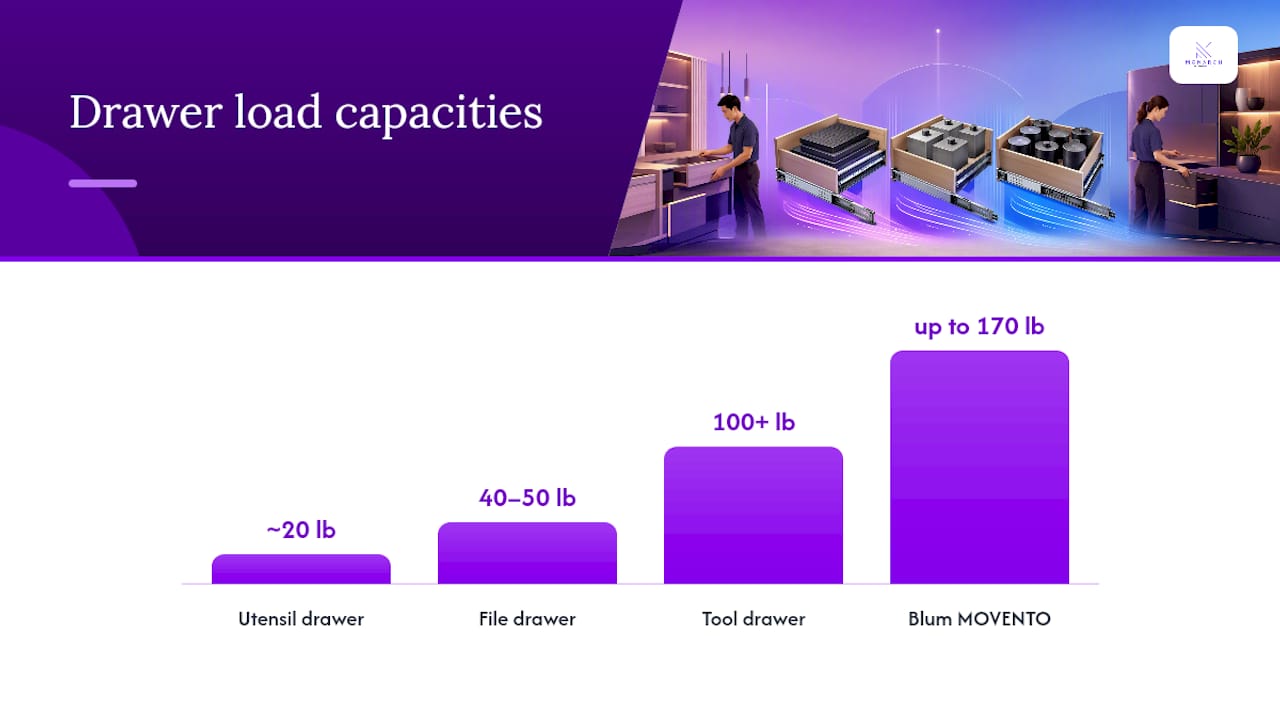
A kitchen utensil drawer rarely exceeds 20 pounds loaded, so a basic roller slide handles it fine. A file drawer packed with hanging folders can easily reach 40 to 50 pounds, which calls for a mid-grade ball-bearing slide. A tool drawer loaded with hand tools or small equipment can climb past 100 pounds, and that’s squarely heavy-duty ball-bearing or premium undermount territory, with static load ratings on some Blum MOVENTO models listed as high as 170 pounds.
Extension type matters just as much as the weight rating:
Partial (three-quarter) extension leaves the back few inches of the drawer inside the cabinet. It’s cheaper and fine for shallow drawers where full access isn’t critical.
Full extension pulls the entire drawer box clear of the cabinet, exposing every inch of interior space, and it’s the expectation in most modern kitchen and closet work.
Over-extension pushes the drawer beyond the cabinet face entirely, occasionally used in specialty storage or accessible-design applications.
When you read a load rating on a spec sheet, treat it as a ceiling, not a target. A slide rated for exactly your expected load leaves no margin for uneven loading, slamming, or a heavier-than-planned drawer down the road. Rockler’s buying guide recommends sizing up rather than cutting it close, and that advice holds whether you’re outfitting a kitchen island or a garage workbench.
Do Materials and Finish Affect How Long Slides Last?
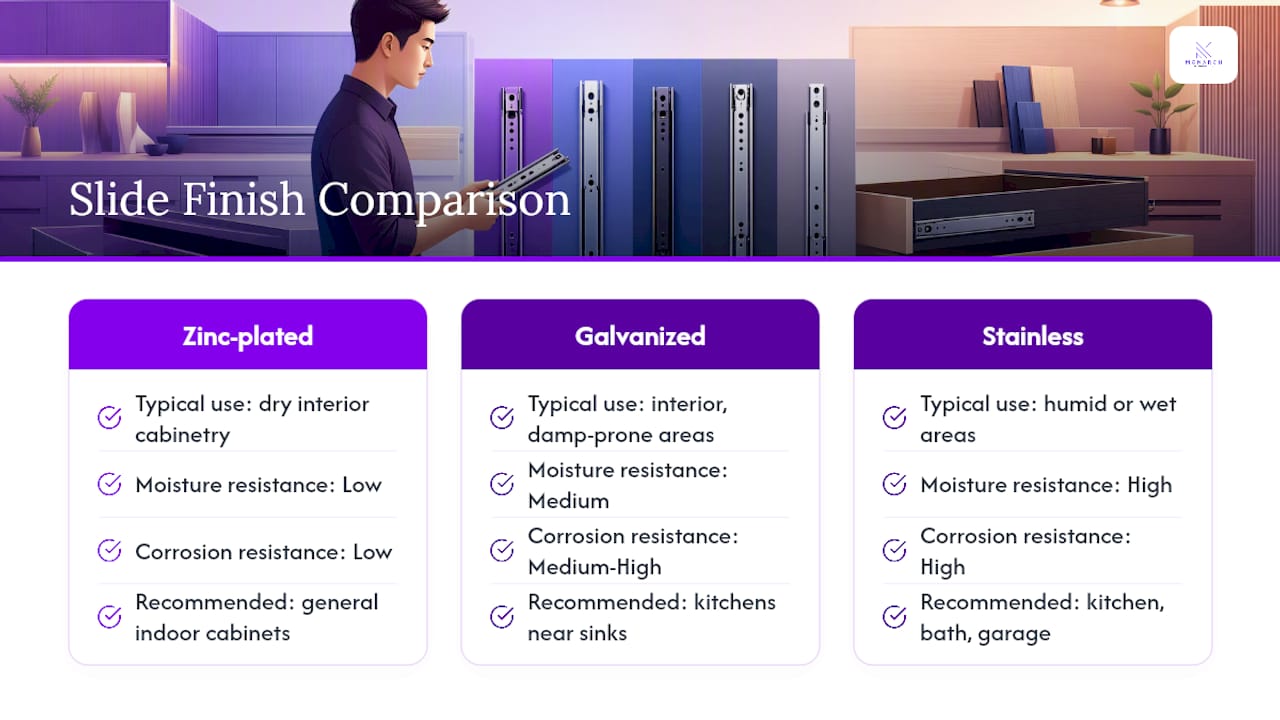
Steel is the standard for slide rails and carriages, but the plating and finish determine how well hardware survives moisture, grease, and daily wear. Zinc-plated steel is common in mid-range hardware and holds up fine in dry interior cabinetry. Stainless steel and galvanized finishes resist corrosion better, which matters in kitchens near sinks, bathroom vanities, or garage cabinetry exposed to humidity.
Wheel and ball-bearing carriage materials matter too. Nylon wheels wear faster under heavy loads but run quietly, while steel ball bearings last longer and carry more weight at the cost of slightly more mechanical noise.
Premium undermount lines back up their materials with real warranty commitments. Datasheets for higher-end systems in the 75 to 120 pound load class often carry limited lifetime warranties and reference recognized performance standards from BIFMA, BHMA, and KCMA. This signals that the hardware has been tested against industry benchmarks rather than marketed on looks alone.
How Do You Choose and Measure for the Right Slide?
Picking the correct drawer slide comes down to five measurements and decisions, taken in order.
Measure the cabinet opening depth. Measure from the front of the cabinet frame to the back interior wall. This is your maximum available slide length.
Measure the drawer box length, from the front panel to the back panel. Slide length is typically chosen based on the shorter of the cabinet depth or drawer box length, minus clearance for hardware.
Decide on extension. If the drawer needs to open fully for deep-drawer access, full extension is worth the added cost over partial extension.
Confirm load and select mounting type. Match expected drawer contents to a weight rating with margin to spare, then choose side-mount, undermount, or center-mount based on available side clearance and how much of the hardware you’re willing to see.
Build your order list. Slides are sold in pairs (one for each side) for side-mount and undermount systems, or as a single unit for center-mount. Undermount systems often require separate front-locking devices or mounting brackets, so check the packaging specs before ordering.
Pro Tip: Only buy a slide slightly longer than the drawer box if the cabinet depth has room to spare and you genuinely need full extension. A slide that’s too long for the opening will bind, and one that’s too short defeats the purpose of upgrading to full extension in the first place.
For anyone building custom cabinetry rather than retrofitting stock drawers, it helps to plan hardware selection at the same stage you’re finalizing cabinet layout and drawer capacity, since slide choice affects how deep and wide a drawer box can be built in the first place.
What Installation Mistakes Ruin Drawer Performance?
Most drawer slide problems trace back to one of four mistakes, and all four are avoidable with careful measuring.
Cabinet openings that aren’t square. Even a slightly out-of-square opening throws off clearance on one side, causing binding or a drawer that drags.
Wrong slide length. A slide too long for the opening won’t seat properly; one too short leaves the drawer unsupported at full extension.
Insufficient side clearance. Side-mount hardware needs that consistent half-inch gap on each side, and skipping this check is the most common reason side-mount slides won’t install cleanly.
Drawer racking on wide drawers, especially with center-mount hardware, where a single support rail can’t resist twisting under uneven loads. Adding lateral stabilizers helps, but the better fix on wide drawers is skipping center-mount entirely.
Once installed, periodic maintenance keeps slides running smoothly: wipe down tracks to clear dust and debris, apply a light lubricant to ball-bearing tracks annually, and watch for grinding or sticking, both early signs a slide is wearing out and due for replacement.
Monarch’s Perspective: Matching Hardware to Bespoke Joinery
On higher-end cabinetry, Monarch carpenters generally recommends concealed undermount systems, since they preserve the clean lines that bespoke joinery is designed to show off. On a recent built-in wardrobe project, switching from a side-mount to an undermount slide let us hide the hardware entirely while adding tool-free adjustment that made the drawer fronts sit flush without shimming.
The biggest lesson from years of shop drawings: specify slide dimensions and mounting type early, during the drawing phase, not after the drawer boxes are built. Undermount hardware in particular needs coordinated drawer-bottom thickness and front-locking devices worked into the shop drawings from day one, or you end up notching drawer boxes on-site to fix clearance conflicts that should never have happened.
Drawer Runner Types: How to Pick the Right Slide for Your Drawer
Most buying guides treat slide selection as a spec-matching exercise: pick a weight rating, pick an extension length, done. That misses the part that actually determines whether the drawer feels right five years in, which is how the hardware interacts with the drawer box itself. A ball-bearing slide rated for 100 pounds means little if the drawer box flexes under that load because the joinery wasn’t built to match.
The conventional advice to “just check the weight rating” also undersells clearance. More installation failures come from a half-inch of missing side clearance than from an undersized load rating. If there’s one thing to prioritize first, it’s measuring the cabinet opening and drawer box before touching a spec sheet, not after.
Soft-close and push-to-open features get marketed as luxury add-ons, but on drawers used daily, they reduce wear on the cabinet face and the slide itself by eliminating slamming. That’s a durability decision as much as a comfort one.
— Seth Wayne
Want the Hardware Chosen for You, Not by You?
Getting slide selection right means measuring correctly, matching load to mechanism, and coordinating clearances before the drawer box is even built. That’s the exact work Monarch carpenters handles as part of every design and build project, so you’re not left cross-referencing spec sheets against a cabinet opening that’s already framed.

Where Monarch carpenters differs from picking hardware off a shelf is timing: we specify slide type, extension, and clearance during the shop-drawing stage, before drawer boxes are cut, which is exactly where most of the installation mistakes covered above actually originate. That coordination is what keeps a concealed undermount system fitting flush years later instead of needing on-site adjustment. If you’re planning a kitchen, wardrobe, or custom cabinetry project in Singapore and want hardware chosen to match the drawer, not the other way around, start with a consultation to see how Monarch carpenters approaches design and build together.
Sources
FAQ
What Are the Three Main Types of Drawer Slides?
The three primary types are classified by mounting position: side-mount, undermount (concealed beneath the drawer), and center-mount. Within each, mechanism types like roller, ball-bearing, soft-close, and push-to-open further define how the drawer moves and performs.
What’s the Difference Between Drawer Slides and Drawer Runners?
“Drawer slides” and “drawer runners” refer to the same hardware and are used interchangeably in the trade. Both terms describe the track-and-carriage system that lets a drawer box move in and out of a cabinet opening.
How Do I Know Which Drawer Slides I Need?
Start by measuring the cabinet opening depth and drawer box length, then decide on extension type and expected load. Match those measurements to a slide rated with margin above your expected weight, and choose the mounting type your cabinet’s side clearance allows, as outlined in Rockler’s guide.
Which Drawer Slide Type Is Best for Heavy Drawers?
Heavy-duty ball-bearing slides are the standard choice for heavy drawers, with some rated to support 100 pounds or more. For premium cabinetry, undermount systems like Blum MOVENTO combine that same ball-bearing strength with concealed mounting, rated up to 170 pounds on certain models.
Does Monarch Carpenters Help Choose Drawer Hardware?
Yes. Monarch carpenters specifies drawer slide type, load rating, and clearance as part of its design and build process, coordinating hardware selection during shop drawings rather than after cabinets are built. Pricing for consultation and design services is available on the Monarch carpenters info page.
Recommended
Comments