
Space Planning in Renovation: A Singapore Guide
- Monarch

- Jun 14
- 8 min read
TL;DR:
Effective space planning in renovation optimizes layout, flow, and functionality before construction begins, saving costs and avoiding mistakes. It involves mapping needs, designing adjacencies, and ensuring circulation to create adaptable, comfortable living spaces. Early professional consultation helps homeowners lock in a practical design that supports future flexibility and long-term sustainability.
Space planning in renovation is defined as the strategic process of organizing interior space to optimize functionality, flow, and comfort before any construction begins. The role of space planning in renovation goes far beyond drawing a floor plan. It determines how you move through your home, how rooms connect, and whether your daily routines feel natural or forced. Space planning is the foundation decision that locks walls, cabinetry, and circulation early, preventing costly mistakes down the line. At Monarch carpenters, we have seen firsthand how this single discipline separates renovations that feel effortless from those that disappoint despite beautiful finishes.
How does space planning shape functional layout and flow?
Space planning, known in the design industry as spatial programming, organizes people, tasks, building systems, and codes so they align within a given footprint. Mapping needs to square footage and defining adjacencies translates your lifestyle requirements into usable rooms. Without this step, even the most expensive materials cannot fix a kitchen that forces you to walk in circles or a bedroom that feels cut off from the rest of the home.

The concept of adjacency is central to good layout planning. Adjacency refers to which rooms or functions need to be physically close to each other. A kitchen adjacent to a dining area reduces the distance you carry food. A home office placed away from the living room reduces noise interference. Poorly planned movement and adjacency make even the best-looking renovations feel frustrating to live in.
Circulation, the path people take through a space, is equally critical. Effective circulation planning means every room is accessible without passing through another room unnecessarily. It also means doorways, corridors, and furniture arrangements leave enough clearance for comfortable movement. For Singapore HDB and condominium units, where square footage is limited, circulation planning is not optional. It is the difference between a home that breathes and one that feels cramped.
Define primary and secondary circulation paths before placing any furniture or cabinetry
Group related functions such as cooking, dining, and food storage in adjacent zones
Identify pinch points where two people might collide or where movement gets blocked
Account for door swings and drawer clearances in tight spaces like kitchens and bathrooms
Pro Tip: Use a simple bubble diagram, circles representing rooms connected by lines showing relationships, to test your layout logic before committing to any measurements. This technique, drawn on paper in minutes, uncovers spatial conflicts that would cost thousands to fix after walls go up.
What are the cost and timeline benefits of planning your layout early?
Effective space planning reduces cost and schedule risk by identifying issues before construction starts, controlling expensive redesigns, and keeping the project moving without surprises. This principle applies directly to residential renovations in Singapore, where contractor schedules are tight and delays compound quickly.
Consider what happens when layout decisions get made after demolition. Moving a wall that was already built costs two to three times more than planning its position correctly from the start. Relocating a plumbing stack after rough-in work is complete can add significant unplanned expense to a bathroom renovation. Locking MEP constraints with space planning early avoids this exact scenario. MEP stands for mechanical, electrical, and plumbing, and these systems must be coordinated with furniture and room placement before any walls close up.
Here is a practical sequence that reduces both cost and risk:
Complete a lifestyle needs assessment before engaging any contractor. List every activity you do at home and the space each requires.
Validate room dimensions with a tape measure and mark furniture footprints on the floor with painter’s tape to test real-world fit.
Identify MEP locations early, including switch positions, outlet placements, and water points, so they align with your planned furniture layout.
Test traffic flow by walking through your taped-out layout at different times of day to catch bottlenecks before walls are built.
Lock your layout before demolition so contractors work from a confirmed plan, not assumptions that generate change orders.
Each step in this sequence prevents a category of expensive mistake. Skipping any one of them is where renovation budgets quietly inflate.
Does space planning support future flexibility and sustainability?
Limiting permanent walls to functional core areas and using movable partitions enhances renovation flexibility and reduces waste over time. This approach is especially relevant for Singapore homeowners whose needs will change as families grow or shrink.
Planning for multifunctional spaces from the start means a study can become a nursery, or a guest room can double as a home gym, without requiring structural work. Flexible furniture systems, modular shelving, and sliding partitions make this possible. The key is deciding during the space planning phase which walls are truly permanent and which can remain adaptable.
Approach | Fixed Layout | Flexible Layout |
Wall type | Permanent brick or concrete | Movable partitions or sliding panels |
Room function | Single dedicated use | Dual or multifunctional use |
Future renovation cost | High, structural changes needed | Low, reconfiguration without demolition |
Waste generated | Significant debris from demolition | Minimal, components reused or repurposed |
Best suited for | Wet areas, structural zones | Living areas, studies, guest rooms |
Engaging occupants during space planning sets clearer goals and improves the long-term sustainability of renovation outcomes. When you articulate how your household actually lives, rather than how you imagine you will live, the resulting layout serves you for years without requiring expensive updates.
Reserve permanent construction for wet areas like bathrooms and kitchens where plumbing is fixed
Use bespoke carpentry for built-ins that serve multiple functions, such as a bed frame with integrated storage
Plan electrical points in flexible zones so furniture can be rearranged without losing access to power
Choose modular furniture systems from the outset so pieces can be reconfigured as needs change
What practical steps help new singapore homeowners plan their space?
Layout validation with real measurements and flow path mapping before reconstruction saves time, money, and improves satisfaction. For new homeowners in Singapore, this process starts with understanding your specific unit type, whether it is an HDB BTO, resale flat, or private condominium, because each has different structural constraints and spatial proportions.
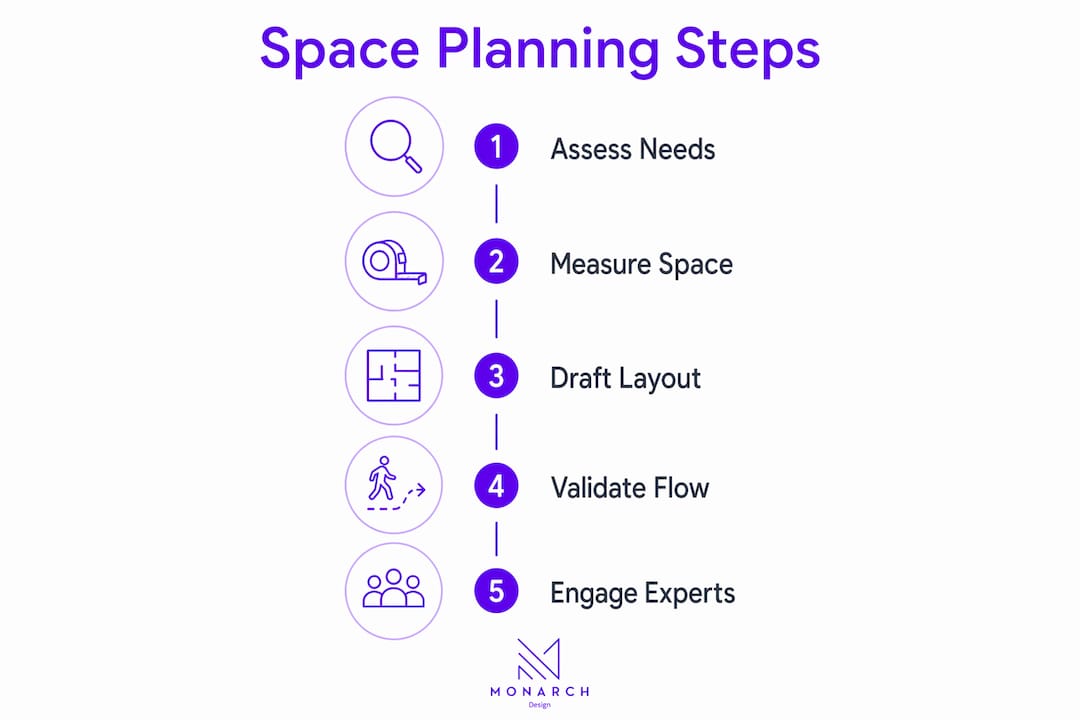
Start with a lifestyle needs assessment. Write down every activity your household performs at home: cooking, working remotely, exercising, entertaining guests, storing bicycles. Assign each activity to a zone or room. Then check whether your current floor plan actually supports those zones in a logical arrangement. This is where many homeowners discover that the layout handed to them by the developer does not match how they actually live.
3D visualizations help ensure layouts work well and reduce surprises during construction. Tools like Planner 5D, RoomSketcher, and SketchUp allow you to model your unit in three dimensions before committing to any contractor. You can test furniture placement, check sight lines, and identify where natural light enters at different times of day. This step costs nothing but time and prevents expensive on-site changes.
Planning Tool | Best Use | Cost |
Painter’s tape floor mock-up | Testing furniture footprints in real space | Free |
Bubble diagram | Mapping room adjacency and flow logic | Free |
Planner 5D or RoomSketcher | 3D visualization of layout and furniture | Free to low cost |
Professional space planning consultation | Integrated MEP and layout coordination | Varies by firm |
Pro Tip: Before your first contractor meeting, prepare a one-page brief that lists your household size, daily routines, storage needs, and any non-negotiable layout requirements. Designers and contractors who receive this brief produce more accurate quotes and fewer change orders.
Engaging professionals early, including interior designers and bespoke carpentry studios like Monarch carpenters, gives you access to space planning expertise for Singapore homes that accounts for local building codes, HDB regulations, and the specific proportions of your unit type. The earlier you bring in that expertise, the more it protects your budget.
For kitchen renovations specifically, a kitchen renovation planning checklist that covers measurement, appliance placement, and traffic flow is one of the most practical tools you can use before committing to cabinetry or countertop selections.
Key takeaways
Effective space planning is the single most important investment a new homeowner can make before renovation work begins, because it protects budget, improves daily comfort, and enables future flexibility.
Point | Details |
Plan layout before construction | Lock walls, MEP, and circulation paths early to avoid costly mid-project changes. |
Adjacency drives daily comfort | Group related functions like cooking and dining to reduce friction in everyday routines. |
Flexibility reduces long-term cost | Reserve permanent walls for wet areas and keep living zones adaptable for future needs. |
Validate with real measurements | Use tape mock-ups and 3D tools before demolition to confirm layouts work in practice. |
Engage professionals early | Bring in designers and carpentry studios at the planning stage, not after decisions are locked. |
Why i think most homeowners plan their renovation backwards
After working with dozens of Singapore homeowners through the renovation process, I have noticed a consistent pattern. Most people start with finishes. They collect tile samples, browse Instagram for kitchen color palettes, and choose their sofa before they have confirmed whether the sofa will physically fit the room. The layout comes last, if it comes at all.
The regret I hear most often is not about material choices. It is about flow. “I wish the kitchen opened toward the dining area.” “I didn’t realize the bedroom door would block the wardrobe.” These are space planning failures, and they are permanent unless you are willing to spend significantly to fix them.
What I have found actually works is treating the layout as the product and the finishes as the packaging. When you get the spatial skeleton right, every finish decision becomes easier because you are working within a framework that already makes sense. The functional skeleton of circulation and adjacency protects downstream contractors from scope creep and assumption mismatches.
Monarch carpenters consistently receives positive feedback from clients not because of any single design choice, but because the planning phase is taken seriously from the first consultation. Clients who invest time in layout validation before construction begins report higher satisfaction and fewer surprises. That outcome is repeatable, and it starts with prioritizing space planning over aesthetics.
— Seth Wayne
How monarch carpenters helps you get the layout right
Monarch carpenters brings together interior design expertise and bespoke carpentry craftsmanship to guide Singapore homeowners through every stage of space planning and renovation.

From the first consultation, the Monarch carpenters team works with you to map your lifestyle needs, validate your layout with real measurements, and coordinate MEP requirements before a single wall comes down. Clients consistently highlight the studio’s ability to deliver refined, functional spaces at a cost that respects real budgets. Whether you are renovating an HDB flat or a private condominium, Monarch carpenters combines technical precision with a collaborative process that keeps you informed and in control. Explore the full range of design and renovation services and see why homeowners across Singapore trust Monarch carpenters to get the planning right the first time.
FAQ
What is the role of space planning in renovation?
Space planning in renovation organizes layout, flow, and function before construction begins, locking key decisions like walls, cabinetry, and circulation to prevent costly mistakes and improve daily comfort.
How does space planning save money during a renovation?
Identifying layout issues before construction avoids expensive redesigns, change orders, and MEP rework that inflate budgets when decisions are made too late.
What tools can singapore homeowners use for space layout optimization?
Painter’s tape floor mock-ups, bubble diagrams, and 3D tools like Planner 5D or RoomSketcher are practical starting points. A professional consultation with a studio like Monarch carpenters adds MEP coordination and code compliance.
How early should i start space planning for my renovation?
Space planning should begin before you engage any contractor. Testing adjacencies before locking wall locations prevents the most expensive downstream problems in any renovation project.
Can space planning help me future-proof my singapore home?
Yes. Limiting permanent walls to wet areas and planning multifunctional zones from the start allows your home to adapt as your household needs change, without requiring structural renovation work later.
Recommended
Comments