
Measure First: 9.4 in Slim or Custom Shoe Cabinet for 16–22 Pairs
- Monarch

- 12 hours ago
- 11 min read
Pick a shoe cabinet by the depth you actually have, not the picture you liked on Pinterest. Under 10 inches of clearance, go ultra-slim flip-drawer. Want seating and hidden storage in one footprint, choose a bench. Odd corners, under-stair gaps, or a need to fit 40-plus pairs without visual clutter. That’s a job for custom carpentry. Slim flip-drawer units typically hold 16 to 22 pairs; benches vary by cube count. The breakdown below covers exact dimensions, materials, and when each option earns its place.
TL;DR:
Ultra-slim flip-drawer cabinets as shallow as 9.4 inches are ideal for narrow hallways and can hold 16 to 22 pairs of shoes across two tiers.
Shoe storage benches provide seating plus hidden compartments, supporting weights of up to 330 pounds for multi-user household convenience.
Proper ventilation with vented panels or louvered doors prevents odor buildup and mold in sealed shoe cabinets, especially in humid climates.
Custom carpentry is cost-effective and offers precise fit for irregular spaces like under stairs or awkward corners, often at a modest price.
Measuring space accurately and considering hardware like soft-close hinges and anti-tip anchors ensures safety, durability, and optimal functionality.
Table of Contents
Shoe Cabinet Design Types for Every Home
Most entryways force a choice between four or five real options, and the right one depends on how much floor space you’re willing to give up and what your household actually does at the front door.
Ultra-slim flip-drawer cabinets solve the narrow-hallway problem better than almost anything else on the market. These units run as shallow as 9.4 inches deep, tuck against a wall without blocking traffic, and hide shoes behind flip-down drawer fronts that stack two or three tiers high. If your hallway is very narrow, this is usually your only comfortable option.
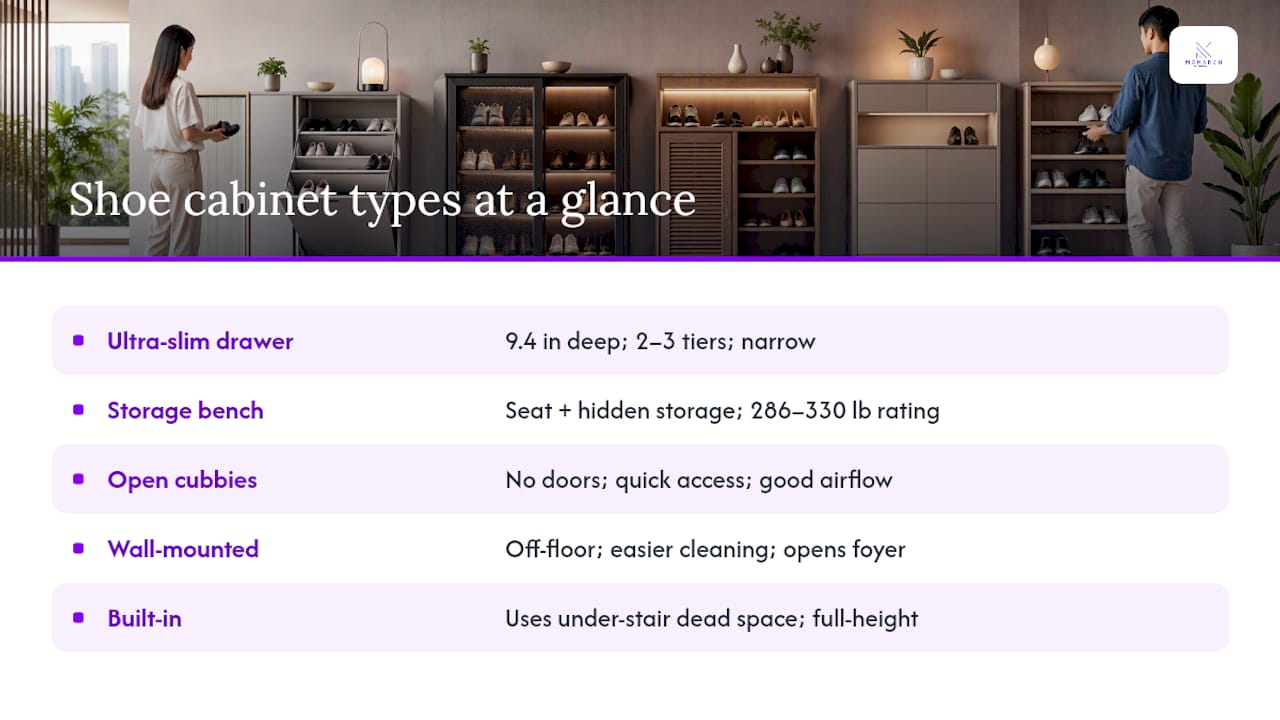
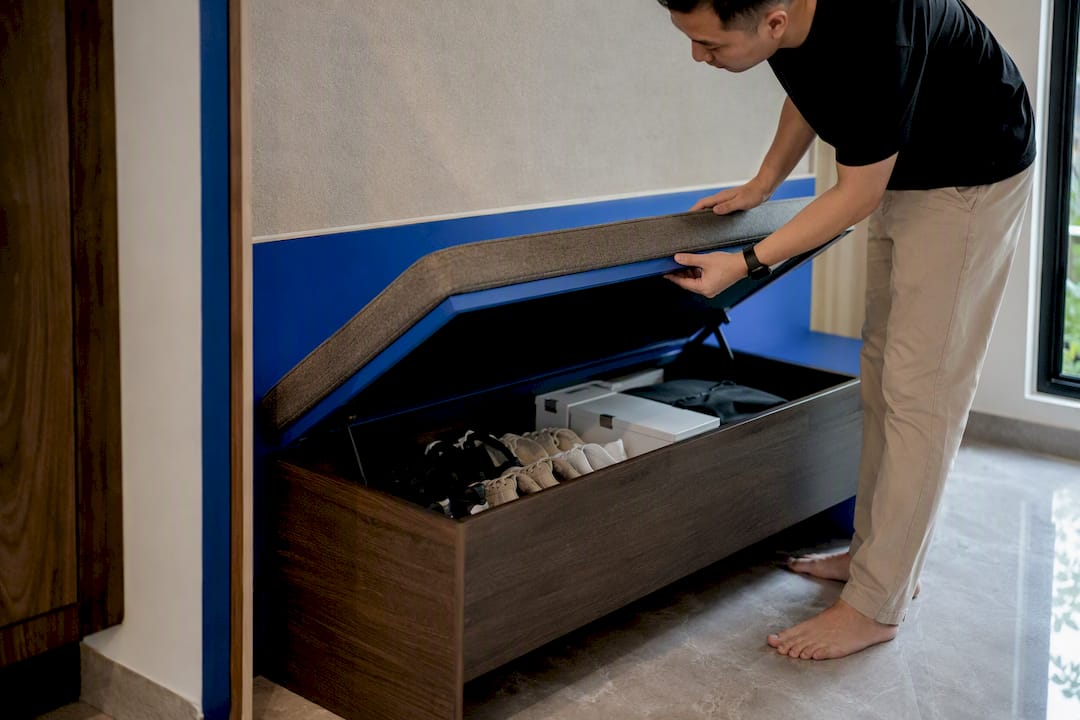
Shoe storage benches do double duty. You get a seat for putting shoes on, plus a hidden compartment or cubby system underneath. Check the load rating before you buy. Multi-functional benches on the market are commonly rated to hold 286 to 330 pounds or more, which matters if two kids are lacing up sneakers at once.
Open cubbies and shelves trade concealment for speed. Anyone in a hurry grabs shoes without opening a drawer, and the open format suits large or rotating collections, sneaker displays, and mudrooms where airflow matters more than tidiness.
Wall-mounted or floating cabinets lift the whole unit off the floor, which frees up sweeping and mopping space and visually opens a tight foyer.
Built-in, under-stair, and floor-to-ceiling cabinetry claims dead space that off-the-shelf furniture simply can’t reach, turning an awkward triangular void under a staircase into a full-height shoe wall.
Shoe Cabinet Dimensions and How Many Pairs You Can Fit
Getting the depth right matters more than getting the width right, because depth is what determines whether the cabinet fits your hallway at all.
Depth guidance:
Ultra-slim units: around 9.4 inches, built specifically for narrow corridors
Standard shallow cabinets: 11 to 14 inches
Storage benches: 13 to 18 inches, deeper to accommodate the seat and compartment below
A typical ultra-slim entryway cabinet measures roughly 23.6 inches wide by 9.4 inches deep by 19.7 inches tall, with drawer interiors around 4.3 inches high, enough for flats and low sneakers but tight for boots. Units at that footprint commonly hold 16 to 22 pairs across two tiers.
Pro Tip: Count your household’s daily-wear shoes separately from seasonal ones. A family of four often needs 20 to 30 slots for regular rotation alone, before boots or occasion shoes enter the picture.
To measure your own space:
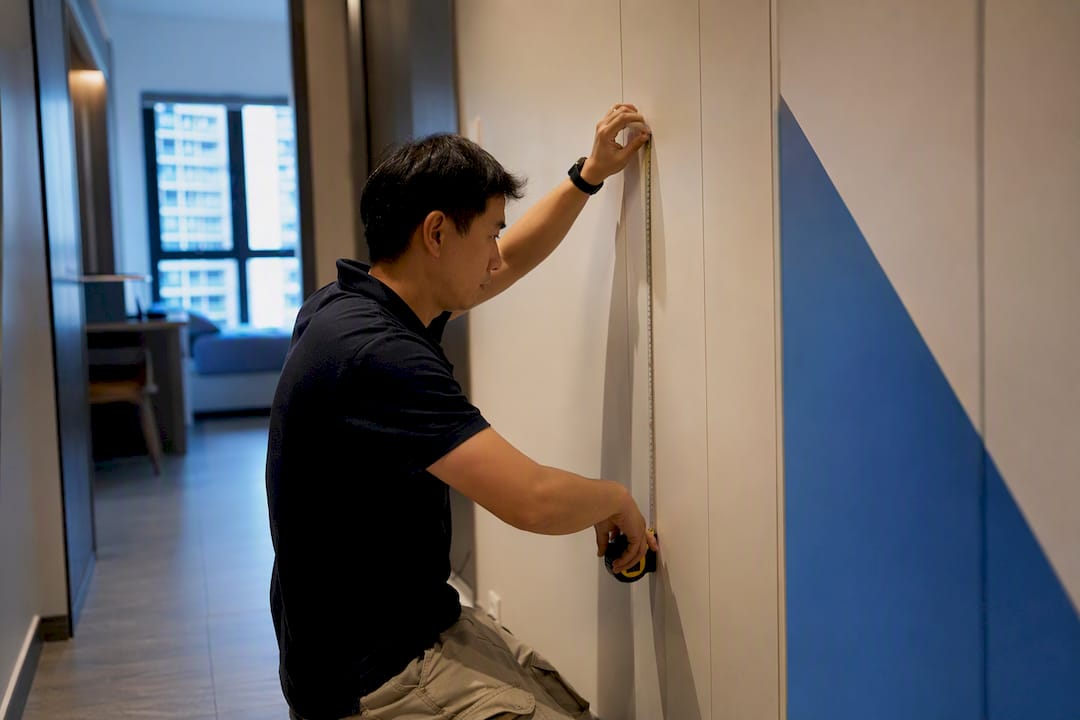
Measure hallway width at its narrowest point, then subtract at least 32 to 36 inches for clear walking path.
Measure available depth against the wall you’re considering.
Count daily-use pairs per household member and add 20% for guests or seasonal swaps.
Compare that number against drawer or cubby capacity before ordering off-the-shelf, or bring the tally to a carpenter for a custom cut list.
Materials, Finishes, and Hardware That Actually Last
The material you choose decides whether your cabinet looks good in year one or year five.
Engineered wood or MDF: budget-friendly, takes paint and laminate well, but swells if it sits in standing moisture near a wet entry.
Plywood or solid wood: stronger joinery, holds screws and hinges longer, and is the standard choice when a carpenter builds a bench meant to bear real weight.
Metal frames: an industrial look with strong moisture resistance, useful in garages or side entries exposed to rain.
For finishes, melamine and laminate wipe clean easily and resist scuffs, veneer gives a furniture-grade look at a lower cost than solid wood, and painted MDF lets you match a custom color scheme exactly.
Hardware is where cheap units fail first. Look for soft-close hinges on flip drawers, anti-tip anchors on anything taller than 40 inches, and, for benches, a cushion with at least medium-density foam so the seat doesn’t compress flat within a year.
Pro Tip: Ask any cabinet maker about anti-tip hardware before you ask about color. A tall slim unit without a wall anchor is a real hazard around curious toddlers.
Placement and Layout for a Cleaner Entryway
Where the cabinet sits changes how well it actually gets used, which matters more than how it looks in isolation.
Foyer or entryway: the most convenient spot, but only works if you have the floor width to spare without blocking the door swing.
Inside a hall closet: hides everything behind a door, ideal for renters who can’t modify walls.
Under the stairs: often wasted triangular space that a custom-built cabinet can claim entirely, tier by tier as the ceiling slopes.
Alcoves and dead-end walls: perfect for a slim unit that would look out of place anywhere else in the room.
Design guides consistently recommend combining a bench, wall hooks, and a small shelf rather than relying on one piece of furniture to do everything. The cabinet top doubles as a staging area for keys and mail, hooks catch bags and jackets at eye level, and a slim mirror above the bench brightens a dim foyer without taking up floor space.
Before installation, confirm door swing clearance, walkway width, and whether you need an electrical outlet nearby for integrated lighting.
DIY, Off-the-Shelf, or Custom Carpentry: How to Decide
DIY makes sense when your space is a standard rectangle, you’re comfortable with basic tools, and you can follow a published cut list without adapting the design. Plenty of step-by-step plans exist for intermediate woodworkers building a modern slim cabinet over a weekend.
Off-the-shelf shopping wins on speed. Retailers stock dozens of ready-made benches and cabinets with published dimensions, and you can have one delivered within days. The catch: catalog listings rarely address awkward layouts, sloped ceilings, or irregular alcoves, because they’re built to fit average rooms, not yours.
Custom carpentry earns its cost when the space fights back. Sloped stair ceilings, an odd nook beside a front door, or a need for 40-plus pairs without a cabinet that looks bulky, that’s where built-to-measure carpentry outperforms modular furniture, because it claims every inch of dead space and integrates trim, lighting, and hidden compartments into one cohesive build.
At Monarch, we’ve found that homeowners are consistently surprised by how modestly priced a custom shoe cabinet can be once you compare it against buying, returning, and rebuying mismatched modular pieces. Our clients tell us the fit and finish, not just the price, is what keeps them coming back for their next room.
A cabinet built to your exact wall, ceiling slope, and shoe count eliminates the wasted gaps that modular furniture almost always leaves behind, and it lets you add features like a glass display front or a hidden charging drawer without the finished piece looking cluttered.
Ballpark timelines for a custom entryway piece typically run from initial measure to installation within a few weeks, depending on finish complexity. See our approach to capacity-first built-in layouts for a sense of how we plan around irregular walls.
Shoe Cabinet Ventilation: Stopping Odor and Mold Before It Starts
Closed shoe storage without airflow is a moisture trap, and moisture is what turns a tidy cabinet into a smelly one.
Louvered doors and vented panels are the simplest fix. A louvered shoe cabinet allows air to circulate through slatted fronts, letting damp shoes dry out overnight instead of sitting sealed against wood. If you already own a solid-front cabinet, drilling a few discreet vent holes near the top and bottom of each compartment achieves a similar effect.
Beyond structural ventilation, a few habits matter just as much as the cabinet design itself:
Let wet or sweaty shoes air out for a couple hours before storing them.
Add a small moisture-absorbing sachet or charcoal bag in humid climates.
Avoid packing drawers past capacity, since tight spacing blocks whatever airflow the design provides.
Wipe down the cabinet interior every few months, especially in coastal or high-humidity regions.
Wood and MDF cabinets are more prone to swelling and mold in damp entries, while metal frames and melamine-finished interiors resist moisture better but still need airflow to prevent odor buildup. If you’re commissioning a custom piece, ask your carpenter to include vented panels or a small gap at the base of each compartment. It’s a simple addition at the design stage and far harder to retrofit later.
Organizational Features Worth Building In
The features inside the cabinet matter as much as the shell around them, and this is where a lot of off-the-shelf units fall short.
Adjustable shelves let you reconfigure the interior as your shoe collection changes, tall boots in winter, flat sandals in summer, without needing a second cabinet. Pull-out drawers beat fixed shelving for anyone who wants to see the whole row of shoes at a glance instead of digging through a stack. Integrated lighting, usually a slim LED strip along the top or inside edge, turns a dark closet corner into something you can actually use without flipping on the hallway light.
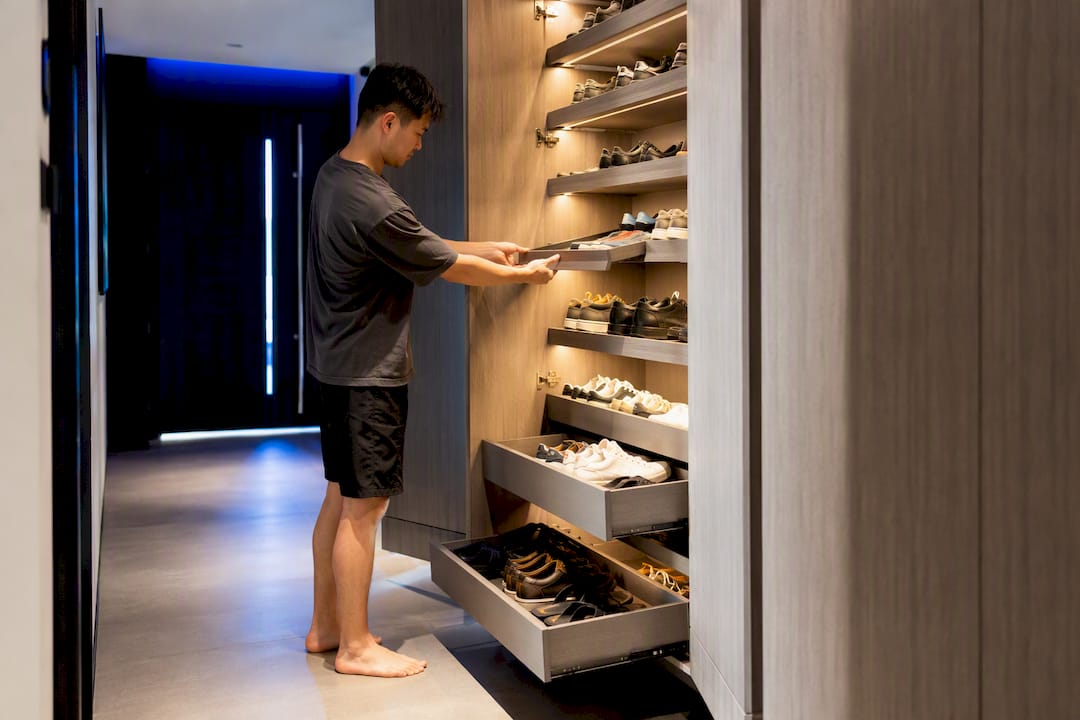
Other details worth requesting: a designated boot compartment with extra height clearance, a small drawer for polish and brushes, and label slots or clear fronts if multiple household members share the cabinet. None of these are difficult additions during a custom build, but they’re almost never available off-the-shelf without paying for a premium model that still won’t fit your exact wall.
Matching Your Shoe Cabinet to Your Interior Style
A shoe cabinet sits at the front door, which means it sets the tone for the whole home before anyone gets past the entryway.
Modern interiors favor flat-front cabinets in matte finishes, often white, gray, or black, with hidden handles or push-to-open mechanisms that keep the facade clean. Rustic spaces lean into visible wood grain, warm stains, and exposed hardware like iron pulls or leather straps on drawer fronts. Minimalist homes tend to hide the cabinet entirely, built flush into a wall or closet so no visible storage furniture interrupts the room.
Color and material choice do most of the work here. A veneer finish in walnut or oak reads as warm and traditional, while painted MDF in a bold color can anchor a more playful, contemporary entry. If your home mixes styles, a neutral cabinet with simple lines tends to bridge the gap better than one that commits hard to a single aesthetic.
Accessibility Considerations for Every Age Group
A shoe cabinet that works for a 30-year-old doesn’t automatically work for a toddler or an aging parent, and that gap shows up fast in daily use.
Lower drawers and cubbies at knee height suit young children building independence with getting dressed. Bench seating helps older adults or anyone with balance concerns avoid bending down to tie laces. Flip-drawer mechanisms should require minimal grip strength, since stiff hinges become a real barrier for arthritic hands over time. Thoughtful accessible furniture design increasingly treats seat height, drawer pull resistance, and reach range as core specs rather than afterthoughts, and that thinking applies directly to entryway furniture.
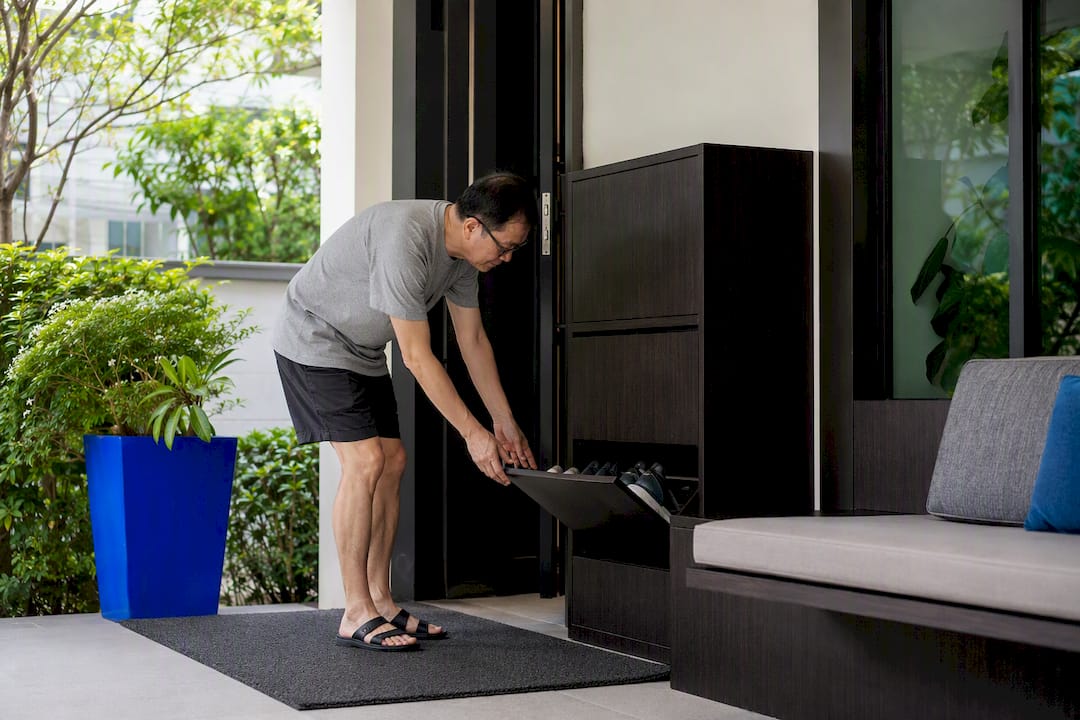
If multiple generations share a household, consider mixing cabinet heights, lower cubbies for kids, a mid-height bench for general use, and taller storage reserved for seasonal items nobody needs daily.
Maintenance and Cleaning Tips for Shoe Cabinets
A shoe cabinet collects more grime than almost any other piece of entryway furniture, simply because of what walks through the door.
Wipe down drawer interiors monthly with a dry or slightly damp cloth, avoiding harsh chemicals on veneer or painted finishes. Vacuum crumbs of dried mud and debris from cubbies before they scratch the surface underneath. Check hinges and drawer slides twice a year, tightening screws and adding a drop of lubricant if flip mechanisms start to stick. For cushioned bench tops, rotate or fluff the cushion periodically to prevent permanent compression, and spot-clean fabric covers rather than soaking them.
Melamine and laminate finishes hold up best against repeated cleaning, while solid wood and veneer need occasional conditioning to avoid drying out. If you notice a musty smell despite regular airflow, it’s usually a sign the cabinet needs a deeper clean or additional ventilation, not just a stronger deodorizer.
Getting the Balance Right Between Style, Function, and Budget
The biggest mistake we see is people designing around a magazine photo instead of their own closet. Measure first. Count what you actually wear daily, not what you own, and build capacity around that number rather than an aspirational one.
Hardware is the second place to spend deliberately. Soft-close hinges and anti-tip anchors cost little relative to the whole project but prevent the two most common complaints we hear: slamming drawers and tipping units.
If you want a sense of what’s possible once measurement and hardware are handled correctly, our built-in storage portfolio shows real layouts solved for narrow hallways and awkward corners.
— Seth Wayne
Get a Custom Shoe Cabinet Design From Monarch Carpenters
If you’ve read this far and your space doesn’t fit neatly into a slim unit or a standard bench, that’s exactly the gap Monarch carpenters exists to close. Our process starts with an in-person site measure, followed by a design proposal that accounts for your exact wall, ceiling slope, or under-stair void, then moves into in-house carpentry and hands-on project management from first cut to final install.

Bring rough dimensions of your entryway and a rough count of your household’s daily shoes to a consultation, and you’ll walk away with a concept sketch, a cost estimate, and a realistic build schedule. Clients consistently tell us they’re surprised how modest the cost turns out to be once they see the finished fit, which is a big part of why our reviews and feedback keep pointing back to the same thing: great design at a modest cost. Visit the Monarch carpenters landing page to request a portfolio review or start your own quote.
Sources
FAQ
What is the standard depth for a slim shoe cabinet?
Ultra-slim units typically measure around 9.4 inches deep, while standard shallow cabinets run 11 to 14 inches.
How many pairs of shoes does a shoe cabinet hold?
A typical ultra-slim flip-drawer cabinet holds about 16 to 22 pairs, while bench-style units vary depending on cube and shelf configuration.
What weight can a shoe storage bench hold?
Many multi-functional shoe benches on the market are rated to support 286 to 330 pounds or more, which suits daily family use.
How do I stop mold and odor in a closed shoe cabinet?
Add louvered doors or vent holes for airflow, let shoes dry before storing them, and use a moisture-absorbing sachet in humid climates.
When should I hire a custom carpenter instead of buying off-the-shelf?
Choose custom carpentry for sloped ceilings, under-stair nooks, or irregular walls where modular furniture leaves wasted gaps; Monarch carpenters specializes in exactly these layouts at a modest cost.
Recommended
Comments