
Carpentry Is 35% of Singapore Renovation Costs: How to Budget and Save
- Monarch

- 3 days ago
- 9 min read

A full renovation in Singapore typically runs from S$30,000 for a light 3-room HDB refresh to well over S$150,000 for a premium landed property overhaul, with most 4-room flats landing between S$55,000 and S$85,000. From there, the single most useful step is booking two or three on-site quotes and requiring a proper Bill of Quantities before you sign anything.
TL;DR:
Most renovation budgets in Singapore are heavily driven by carpentry, which accounts for about 35 to 45 percent of total costs, especially for custom built-ins.
Structural alterations such as hacking walls or relocating toilets can add S$3,000 to S$15,000 or more, significantly raising overall expenses.
To avoid scams, homeowners should request detailed Bills of Quantities, verify contractor registration and insurance, and compare at least three quotes based on the same scope.
Staged payments and written change orders help manage risks from unexpected issues like hidden plumbing or material delays during renovation.
Budgeting around S$55,000 to S$85,000 for a mid-tier 4-room HDB flat is typical, with costs rising substantially for resale units, condos, or landed properties.
Table of Contents
How Much Does Renovation Cost in Singapore by Property Type?
Where Does the Money Actually Go? A Trade-by-Trade Breakdown
What Drives Your Quote Up, and What Should Make You Walk Away?
How Do You Get Accurate Quotes and Vet a Contractor Properly?
Why Homeowners Trust Monarch Carpentry Design Studio With Their Budget
How Much Does Renovation Cost in Singapore by Property Type?
Renovation cost in Singapore splits into three practical tiers: light (cosmetic touch-ups), mid (a proper overhaul with new wet works and carpentry), and premium (full customization, higher-grade materials, and structural changes). Which tier fits your project depends less on the property type and more on how much you’re changing.
For a BTO or new HDB flat, you’re mostly working with a blank canvas, so costs skew toward carpentry and finishes rather than demolition. New 4-room units range from roughly S$25,000 to S$95,000 depending on tier, according to ShiokNest’s 2026 cost guide.
Resale HDB flats cost more at every tier because you’re paying to undo someone else’s choices first. A realistic full renovation budget for resale units generally falls between S$30,000 and S$90,000, and resale units typically run higher within that band because of necessary hacking and repair work, per Nearme. Specifically:
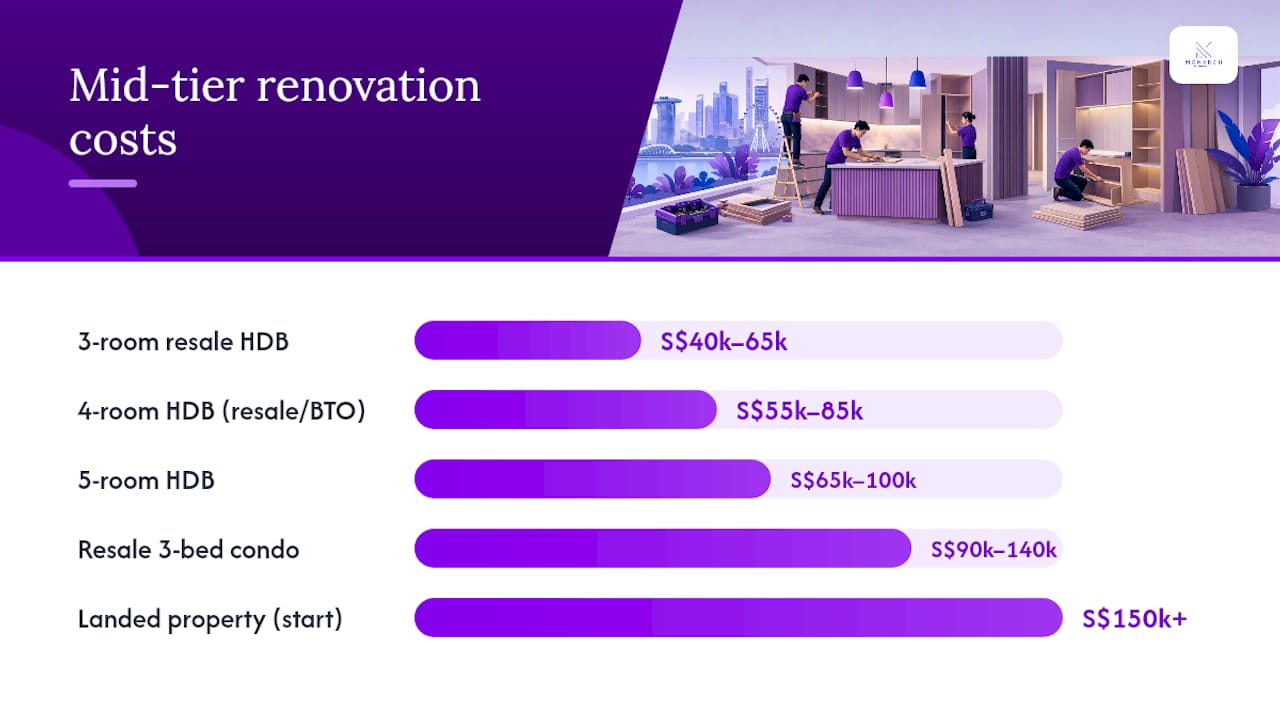
3-room resale HDB: light S$25,000–40,000; mid S$40,000–65,000; premium S$65,000–100,000+
4-room HDB (BTO or resale): light S$35,000–55,000; mid S$55,000–85,000; premium S$85,000–130,000, based on KakiList’s 2026 price guide
5-room HDB: light S$40,000–65,000; mid S$65,000–100,000; premium S$100,000–150,000+
Condo (1 to 3 bedrooms): ranges widely by finish level, with resale 3-bedroom condos landing in the mid S$90,000–140,000 range
Landed property: typically starts above S$150,000 and climbs quickly once structural work, multiple bathrooms, and outdoor spaces enter the scope
A worked example makes the formula concrete. Say you own a 1,000 square foot 4-room resale flat and you’re planning a mid-tier renovation at a planning rate of S$60 per square foot. This formula, outlined by NearMe.SG, gives you a starting number, not a final one. Actual pricing still depends heavily on what your unit looks like underneath the surface and how many walls you plan to move.
Where Does the Money Actually Go? A Trade-by-Trade Breakdown
Carpentry eats the biggest slice of almost every Singapore renovation budget, and it’s usually the category homeowners underestimate the most.
Custom carpentry (kitchen cabinets, wardrobes, TV consoles, built-in storage) typically accounts for 30 to 40% of total spend, and can climb toward 45% on projects heavy with bespoke joinery, according to ShiokNest.
By the numbers: carpentry ~35%, wet works ~25%, electrical ~15%, flooring ~10%, and painting/plastering ~8% of a typical renovation budget, per category splits published by ShiokNest.
Translated into unit costs, a full bathroom renovation (retiling, waterproofing, new fittings) commonly runs S$8,000 to S$15,000 per room. A standard kitchen cabinet run, upper and lower cabinets across a 10 to 12 foot wall, lands between S$8,000 and S$18,000 depending on material and finish. A full home rewire for a 4-room flat typically costs S$3,000 to S$6,000.
The custom-versus-modular carpentry decision matters more than most homeowners realize:
Custom built-ins cost more but fit odd corners, maximize awkward spaces, and match your finish exactly.
Modular carpentry systems run 30 to 50% cheaper than custom work, per ShiokNest’s data, though they offer less tailoring to your unit’s specific dimensions.
A hybrid approach, custom carpentry in high-visibility areas and modular elsewhere, often delivers the best value.
What Drives Your Quote Up, and What Should Make You Walk Away?
Four factors explain most of the variance between two quotes for what looks like the same job. Scope of hacking and structural work tops the list. Removing a wall, relocating a toilet, or reconfiguring a kitchen layout typically adds S$3,000 to S$15,000 or more on top of base renovation costs, per KakiList. Material grade is the second driver: laminate, quartz, and natural stone can each roughly double the cost of the surface below them, so picking one or two premium splurges while keeping the rest mid-range controls the total far better than upgrading everything at once. Access and logistics (high floors, no lift access, strata restrictions on work hours) add labor time. Permits and specialist trades round out the list, particularly for gas, structural, or electrical work that requires licensed sign-off.
Watch for these red flags when reviewing quotes:
A deposit request above 30 to 40% of the total contract value before work begins.
A quote with no line-item breakdown, just a single lump sum.
No Bill of Quantities offered, even after you ask for one.
A contractor who can’t show registration for permitted works or valid insurance.
Unusually low pricing with vague justification. Unregistered contractors asking for over 50% upfront is a documented scam pattern in Singapore’s renovation market, according to KakiList.
Pro Tip: Ask every contractor to quote against the identical scope document. If one number looks too good, check whether they’ve quietly excluded hacking, disposal, or electrical work from their price.
How Should You Budget and Pay for a Renovation?
Staged payments protect you from the two worst outcomes in renovation: a contractor who disappears mid-project, and a contractor who runs out of cash before finishing your unit. A common, sensible structure looks like this:
10 to 20% on signing, to confirm commitment and begin material procurement
30% once hacking and structural work is complete, tying payment to visible progress
30% at fit-out completion, once carpentry, tiling, and electrical work are substantially done
20% at final handover, held back until you’ve inspected the finished unit
This staging, outlined by KakiList, means you’re never paying far ahead of completed work.
For financing, most homeowners draw from savings first, then consider a personal or renovation loan for the gap. Bank renovation loans typically run 1 to 5 year tenures with variable rates, and the advertised rate rarely tells the full story. Compare the Effective Interest Rate (EIR) across lenders rather than the flat rate, as ShiokNest notes, since EIR reflects the true annualized cost once fees are factored in.
How Do You Get Accurate Quotes and Vet a Contractor Properly?
Your first call should cover scope, timeline, and whether the contractor offers a free site visit; most reputable providers do, though some charge a small fee that’s waived if you proceed, per KakiList. During the site visit, ask about access constraints, expected hacking scope, and how change orders get priced.
A proper Bill of Quantities (BOQ) should list line-item unit prices for every material and labor component, not a single bundled figure. That level of detail, as NearMe.SG explains, lets you convert a lump-sum quote into an apples-to-apples comparison and price minor changes without surprises later.
Before signing, run through this checklist:
Confirm registration for any permitted works requiring licensing.
Verify insurance coverage for workers and property damage.
Review a portfolio of completed projects similar in scope to yours.
Ask what warranty covers carpentry and wet works, and for how long.
Line up 2 to 3 quotes against the identical scope document before deciding.
Compare quotes trade by trade, not just by bottom-line total, since one contractor may bundle carpentry and painting differently than another.
Where Can You Save Without Sacrificing Durability?
The biggest lever is carpentry scope. Choosing mid-range finishes for large surface areas (flooring, wall tiles) while reserving splurges for one or two focal points, a feature wall or a statement countertop, keeps the visual impact without the full premium price tag.
Overlaying new flooring over existing tiles, where the substrate allows it, avoids hacking costs entirely and speeds up the timeline.
Some areas aren’t worth cutting corners on. Wet works, waterproofing, and electrical safety directly affect your home’s structural integrity and your family’s safety, so spend accordingly there.
Stick to standard cabinet and countertop dimensions where possible.
Reuse existing plumbing routes instead of relocating fixtures.
Plan storage layouts early to avoid costly carpentry revisions mid-project.
Pro Tip: Spend on what you can’t easily redo later (waterproofing, wiring) and save on what you can upgrade in five years (loose furniture, light fixtures).
Why Homeowners Trust Monarch Carpentry Design Studio With Their Budget
Monarch carpenters built its reputation on a simple idea: elegant design and disciplined cost control aren’t opposites. Our in-house team of designers and carpenters works under one roof, which means fewer handoffs, fewer miscommunications, and fewer surprise costs than projects split across separate design and contracting firms.
Because carpentry typically represents the largest single line in a renovation budget, having that expertise in-house is where Monarch carpenters delivers the clearest advantage. We scope carpentry against your actual Bill of Quantities, stage payments transparently, and flag where modular solutions can replace custom work without compromising the look you want.
Homeowners planning a kitchen renovation can start with our kitchen renovation planning checklist, and anyone weighing whether to hire a dedicated interior designer versus a direct contractor should read our breakdown of the interior designer’s role in a Singapore renovation.
What Renovation Surprises Actually Look Like on the Ground
Two surprises show up more often than any others. Old plumbing behind bathroom walls, invisible until hacking begins, and lead times on imported materials running longer than the initial schedule assumed. Both are manageable if you’re ready for them.
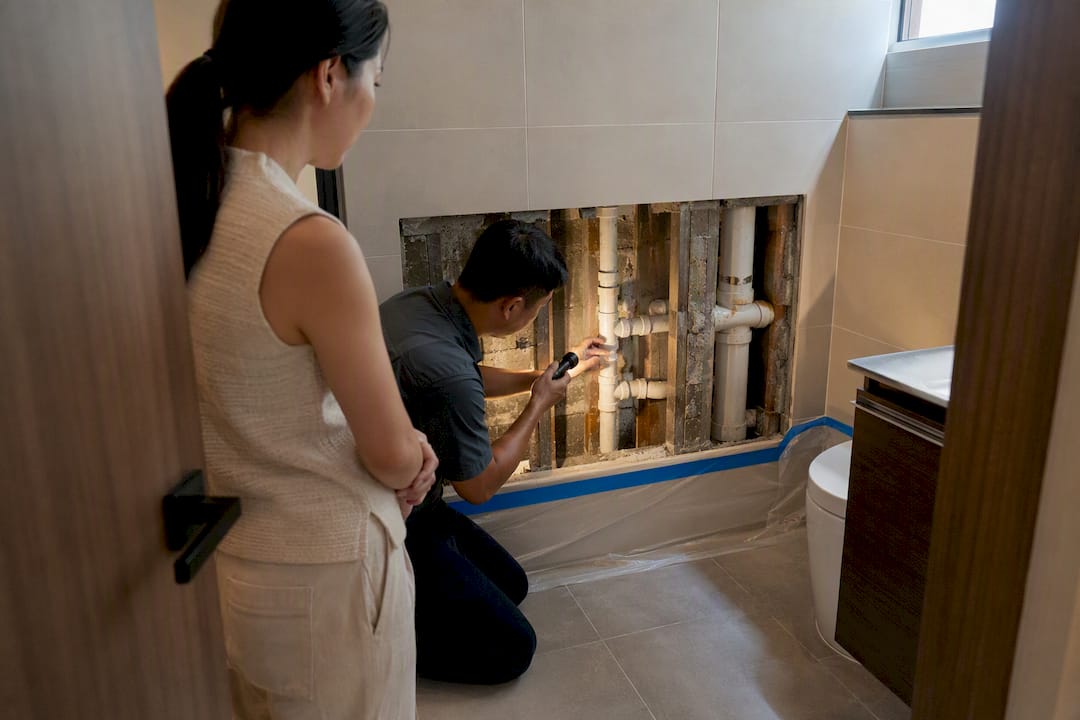
When something unexpected turns up mid-project, pause the affected trade, get the change documented against your BOQ with a revised price, and adjust your contingency line before work resumes. Never let a verbal “it’ll be a bit more” substitute for a written change order.
Renovations rarely go exactly to plan, but clear communication and a real contingency buffer turn most surprises into manageable line items instead of budget disasters.
— Seth Wayne
Ready to Plan Your Renovation Budget With Confidence?
Monarch carpenters gives you something most contractors can’t: design and carpentry under one in-house team, so your budget doesn’t inflate through handoffs between separate designers, contractors, and carpentry subcontractors. That structure is exactly why our staged project management and transparent Bills of Quantities tend to hold up better against the surprises that blow up other renovation budgets.

If you’re ready to put real numbers against your own renovation, reach out through the Monarch carpenters landing page for a cost review and planning checklist tailored to your unit. We’ll still recommend you gather two or three quotes elsewhere too. A transparent partner should never be afraid of comparison, and we’d rather earn your project on the strength of our numbers and our craftsmanship than on the absence of alternatives.
Where These Numbers Come From
The cost ranges and formulas in this guide draw from KakiList’s 2026 renovation price guide, NearMe.SG’s home renovation budgeting guide, ShiokNest’s Singapore renovation cost guide, and Qanvast’s renovation cost calculator. Check the latest version of these calculators before finalizing your own budget, since material and labor costs shift year to year. Homeowners tackling older units should also review guidance on renovating homes that may contain asbestos before any hacking work begins.
Sources
FAQ
How much does it cost to renovate a 1,000 square foot condo in Singapore?
Using the floor area formula, a 1,000 square foot condo at a mid-tier planning rate typically lands in the mid S$90,000 to S$140,000 range before contingency, though resale condos with older wet works often run higher.
Can you renovate a bathroom for $10,000 in Singapore?
Yes. A full bathroom renovation, including retiling, waterproofing, and new fittings, commonly costs between S$8,000 and S$15,000.
What is the average renovation cost in Singapore?
Most full home renovations fall between S$30,000 and S$90,000, with 4-room HDB flats averaging S$55,000 to S$85,000 for a mid-tier finish and landed properties often exceeding S$150,000.
Can I renovate my bathroom for $5,000?
It’s tight but possible for a light-tier refresh, cosmetic tiling and fixture swaps without moving plumbing or redoing waterproofing, though most contractors will quote closer to S$8,000 for a full scope.
Recommended
Comments