
Types of Compact Kitchen Layouts for Singapore Homes

TL;DR:
Singaporean compact kitchens require careful layout planning to optimize space, workflow, and storage. The most suitable options include single-wall, galley, L-shaped, U-shaped, or peninsula layouts, selected based on room shape, size, and cooking habits. Using mockups and custom cabinetry enhances functionality and visual cohesion, ensuring a practical and efficient kitchen design.
Singapore apartments are famously space-conscious, and the kitchen is usually where that pressure shows up first. Choosing the right types of compact kitchen layouts can mean the difference between a kitchen that frustrates you every morning and one that genuinely works for how you cook and live. This guide walks through the most practical layout options available, with clearance standards, storage strategies, and design tips tailored to the realities of Singapore’s residential floor plans.
Table of Contents
Key takeaways
Point | Details |
Layout type determines workflow | Each compact layout suits different room shapes, cooking habits, and household sizes. |
Clearance is non-negotiable | The NKBA recommends at least 42 inches for single-cook aisles and 48 inches for multiple cooks. |
Custom cabinetry beats modular | Bespoke carpentry eliminates filler gaps and maximizes every usable inch in tight kitchens. |
Integrated appliances open up space | Panel-ready appliances reduce visual clutter and make small kitchens feel significantly larger. |
Validate before you commit | Tape-out mockups on the floor help confirm clearances and catch layout problems before construction begins. |
1. Types of compact kitchen layouts: the single-wall option
The single-wall layout places every appliance, cabinet, and countertop along one wall. It is the most space-efficient configuration available and works particularly well in studio apartments and narrow HDB units where the kitchen shares an open space with the living or dining area.
The layout’s biggest strength is simplicity. There are no corners to deal with, no wasted turning radius, and the kitchen workflow stays linear and predictable. The trade-off is countertop depth. A single wall typically offers less prep surface than any other layout, so every inch of counter must be used deliberately.
Key considerations for single-wall kitchens:
Keep the sink centered between the cooker and refrigerator to minimize steps during food prep.
Use full-height cabinetry to capture vertical storage that the horizontal footprint cannot provide.
Add a fold-down counter extension or a slim rolling cart for extra prep space when needed.
Avoid overhead cabinets that are too deep, as they can make a narrow space feel oppressive.
Pro Tip: In a single-wall kitchen, the order of appliances matters more than most people realize. Place the refrigerator at the entry end so family members can grab drinks without crossing the cooking zone.
2. Galley kitchen layouts for narrow Singapore spaces
The galley layout runs two parallel rows of cabinets and counters along opposite walls, with a central aisle between them. It is one of the most efficient kitchen layouts for cooking because everything is within arm’s reach and the workflow stays contained.
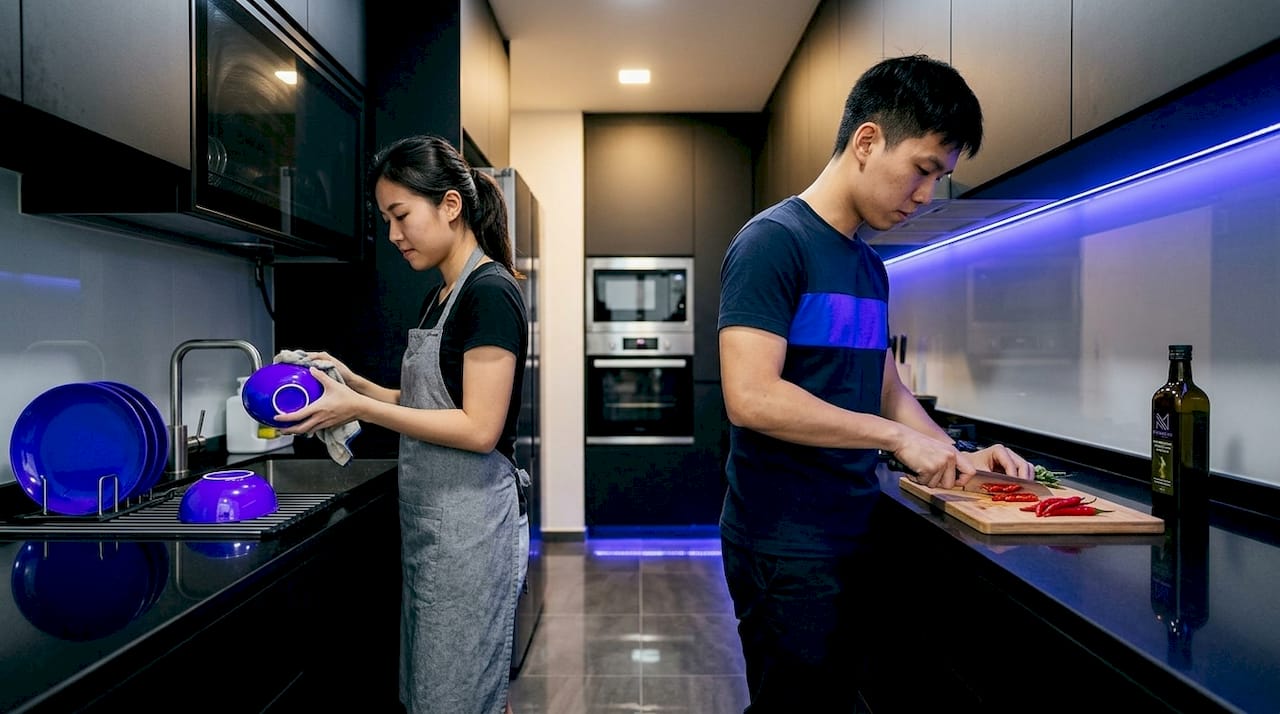
The aisle width is the critical variable. The NKBA clearance standard requires at least 42 inches for a single cook and 48 inches when two people cook simultaneously. In Singapore apartments where the kitchen corridor might measure only 6 to 7 feet across, this leaves little room for error.
One common design mistake in galley kitchens is placing tall units, like a full-height pantry or refrigerator, in the middle of a run. This creates a visual tunnel effect that makes the space feel smaller and more enclosed. Instead, position tall units at one end of the galley to keep sightlines open and the space feeling airy.
Galley kitchens also benefit from:
Matching upper and lower cabinet depths to maintain a clean, uniform profile.
Installing under-cabinet lighting to brighten the work surface without adding bulk.
Using a single continuous countertop material to visually lengthen the space.
3. L-shaped kitchen plans for corner-to-corner efficiency
The L-shaped layout uses two adjoining walls, forming a natural right angle that separates cooking zones without requiring a physical partition. This configuration suits Singapore apartments with a dedicated kitchen room that opens toward a dining area, making it a popular choice for three-room and four-room HDB flats.
The L-shape’s greatest advantage is its natural zoning capability. You can dedicate one arm to wet tasks like washing and prep, and the other arm to dry tasks like cooking and plating, without the zones ever crossing. This separation matters more than most homeowners expect, especially when two people are working in the kitchen at the same time.
Corner storage is where L-shaped kitchens often lose efficiency. The dead corner where the two walls meet can become a black hole for rarely used items unless it is fitted with a purpose-built solution:
Lazy Susan rotating shelves make deep corner cabinets fully accessible.
Corner pull-out drawers bring items to the front rather than forcing you to reach inside.
Open corner shelving works well for frequently used items like oils and spices.
Pro Tip: When planning an L-shaped kitchen, keep the two arms roughly equal in length. An imbalanced L, where one arm is significantly shorter, tends to create a cramped cooking zone and an underused prep zone.
4. U-shaped kitchen designs for maximum prep space
The U-shaped layout wraps cabinetry and counters around three walls, enclosing the cook on three sides. It offers more countertop and storage than any other compact configuration, which is why it suits households that cook frequently and need space for multiple appliances, ingredients, and tools.
The clearance requirement between facing counters is the same as a galley: 42 to 48 inches depending on the number of cooks. The challenge in Singapore homes is that many kitchens simply do not have enough width to accommodate a U-shape without the aisle feeling uncomfortably tight. A room width of at least 8 feet is generally the minimum, and 10 feet or more is preferable.
Corner storage solutions are doubly important in a U-shaped kitchen because there are two corners to address. The same Lazy Susan and pull-out drawer options apply, and many designers recommend dedicating one corner to a tall pantry unit with pull-out shelves, which turns an otherwise awkward space into the most organized part of the kitchen.
Pro Tip: In a U-shaped kitchen, place the refrigerator at the open end of the U, not tucked into one of the corners. This keeps it accessible to non-cooks without disrupting the cooking workflow.
5. Adding islands and peninsulas to compact kitchens
An island or peninsula can add meaningful prep space, seating, and visual separation in a compact kitchen, but only when the room dimensions genuinely support it. Fixed kitchen islands generally require a room width above 10 feet to maintain safe clearances on all sides. In rooms narrower than that, a fixed island creates traffic bottlenecks rather than solving them.
When a fixed island is not feasible, a movable butcher block cart is a practical alternative. It provides extra prep surface and storage, rolls out of the way when not needed, and costs a fraction of a built-in island. Movable carts outperform fixed islands for maintaining flow and functionality in kitchens under 10 feet wide.
A peninsula, which connects to the main cabinetry on one end, is often a smarter choice than a freestanding island in compact Singapore kitchens. It adds seating on the open side, creates a natural boundary between the kitchen and living area in open concept kitchens, and requires clearance on only three sides rather than four.
Before committing to any island or peninsula, consider:
Mapping all door swings to confirm they clear the new structure without conflict.
Checking that the aisle on each open side meets the 42-inch minimum.
Deciding whether the island will include a sink or cooktop, which requires plumbing or electrical work that affects positioning.
Pro Tip: Tape-out mockups of your proposed island on the floor using painter’s tape before any construction begins. Walk through the space with groceries in hand. You will immediately feel whether the clearances are genuinely comfortable or just technically sufficient.
6. Visual integration and storage maximization techniques
A well-planned layout can still feel cluttered if the visual design is not handled with care. Panel-ready, integrated appliances reduce visual noise and help small kitchens feel larger, a principle that experienced designers consistently apply in compact spaces. When your refrigerator, dishwasher, and even your range hood share the same cabinet face, the kitchen reads as one cohesive unit rather than a collection of competing objects.
Continuous custom cabinetry takes this further by eliminating the filler strips and awkward gaps that modular systems leave behind. Bespoke cabinetry built to your kitchen’s exact dimensions can increase countertop and cabinet space significantly without moving a single wall.
Here is how these strategies compare in practice:
Strategy | Visual impact | Storage gain | Cost level |
Panel-ready appliances | High | None | Medium |
Continuous custom cabinetry | Medium | High | Medium to High |
Vertical storage additions | Low | Medium | Low |
Open shelving | Medium | Low | Low |
Appliance garages | Low | Medium | Low to Medium |
Beyond appliances and cabinetry, lighting plays a significant role in perceived space. Under-cabinet strip lighting eliminates shadows on the work surface and makes the kitchen feel brighter and more open. Lighter cabinet finishes in matte or satin reflect more light than high-gloss surfaces, which can create distracting reflections in small rooms.
Pro Tip: If your budget allows only one upgrade, choose integrated appliances over any other aesthetic change. The visual impact of removing exposed appliance bodies from a small kitchen is immediate and dramatic.
7. Choosing the best compact kitchen layout for your Singapore home
With several layout options available, the right choice comes down to four factors: room shape, cooking frequency, number of cooks, and budget. This comparison table gives you a starting point.
Layout | Minimum room width | Storage capacity | Best for |
Single-wall | 6 feet | Low | Studios, narrow spaces |
Galley | 7 feet | Medium | Solo cooks, narrow rooms |
L-shaped | 8 feet | Medium to High | Couples, open-plan homes |
U-shaped | 10 feet | High | Frequent cooks, larger kitchens |
Peninsula | 9 feet | High | Open concept kitchens |
Modern designers have largely moved away from the classic work triangle as the primary planning tool. Functional zoning and appliance proximity are now considered more relevant in compact kitchens, where the goal is to group related tasks rather than connect three fixed points.
For Singapore homeowners, the most practical first step is to consult your kitchen renovation checklist before making any layout decisions. Knowing your existing plumbing positions, electrical points, and structural walls will immediately narrow your options and prevent costly changes mid-project.
Pro Tip: Use painter’s tape on your actual floor to mark out each layout option before committing to any design. Walk through the motions of cooking a full meal in each configuration. The layout that feels most natural in practice is almost always the right one.
My honest take on compact kitchen layouts in Singapore
I’ve spent years looking at compact kitchen projects, and the single lesson that stands out above everything else is this: most homeowners underestimate how much clearance matters and overestimate how much storage they need.
In my experience, the layouts that consistently disappoint are the ones where someone squeezed in a fixed island because it looked good on a floor plan, only to discover that two people cannot pass each other without turning sideways. I’ve seen this happen in kitchens where the aisle measured 38 inches on paper and felt perfectly reasonable as a number. In practice, it creates daily frustration.
What I’ve found actually works is validating every clearance with a physical tape-out before any design is finalized. Walk through the space. Open the oven door. Pretend you are pulling a pot off the stove. The difference between a layout that works and one that merely looks good on screen is almost always discovered in that 10-minute exercise.
Custom cabinetry also changes the equation more than most people expect. Standard modular units leave gaps, force compromises, and rarely fit a Singapore kitchen’s exact dimensions. Bespoke carpentry built to the millimeter gives you storage in places modular systems simply cannot reach, and it makes the finished kitchen look considered rather than assembled.
My advice: prioritize workflow over aesthetics in the planning stage. A kitchen that moves well will always feel beautiful to the person cooking in it. A kitchen that looks beautiful but fights you every time you cook will wear on you faster than you think.
— Seth Wayne
Transform your kitchen with Monarch Carpenters
If you have been reading this and mentally mapping your own kitchen, you are already thinking the way our clients do when they first come to us. At Monarch Carpenters, we specialize in bespoke kitchen carpentry and layout planning for Singapore homes, and our clients consistently tell us that the quality of the craftsmanship surprised them given how accessible our pricing is. That feedback means everything to us.

Whether you are working with a narrow HDB galley, an L-shaped condominium kitchen, or an open-plan layout that needs a thoughtful peninsula, our in-house team of designers and carpenters will work through every detail with you. Explore our work and learn more about what we do at Monarch Carpenters. We would love to help you build a kitchen that is as practical as it is beautiful.
FAQ
What is the most space-efficient compact kitchen layout?
The single-wall layout is the most space-efficient option for very small kitchens, as it consolidates all appliances and storage along one wall and leaves the maximum floor area open.
How much aisle space does a compact kitchen need?
The NKBA standard recommends a minimum of 42 inches for a single-cook work aisle and 48 inches when two or more people cook at the same time.
Can I add an island to a small Singapore kitchen?
Only if your kitchen is at least 10 feet wide. In narrower spaces, a movable butcher block cart or a peninsula connected to existing cabinetry is a more practical and functional alternative.
What is the best layout for an open concept kitchen in Singapore?
An L-shaped or peninsula layout works best for open concept kitchens because it creates a natural boundary between the kitchen and living areas without requiring a wall or partition.
Why does custom cabinetry matter more than modular units in compact kitchens?
Custom cabinetry is built to your kitchen’s exact dimensions, eliminating the filler gaps and wasted corners that modular systems leave behind, which translates directly into more usable storage and counter space.
Recommended
Comments