
Carpentry vs Ready-Made Furniture: How to Choose
- Monarch

- 12 minutes ago
- 11 min read
TL;DR:
Custom carpentry is best for high-use, permanent built-ins like kitchens and wardrobes, where durability matters most. Ready-made furniture suits quick, lightweight, or temporary needs such as kids’ rooms and rental units. Investing in custom pieces offers longer lifespan through quality materials and traditional joinery, while ready-made options prioritize speed and cost-effectiveness.
Choose custom carpentry for high-use, permanent built-ins — kitchens, main wardrobes, media walls — and ready-made for fast, low-cost, or temporary needs. The single rule that simplifies every room decision: invest custom where you live daily, buy ready-made where you live lightly. That “hero-piece” principle, recommended consistently by designers, means you don’t have to choose one approach for your entire home.
Kitchen cabinetry and pantry walls: Custom wins. Irregular walls, plumbing offsets, and ceiling height variations make standard sizes a compromise every single day.
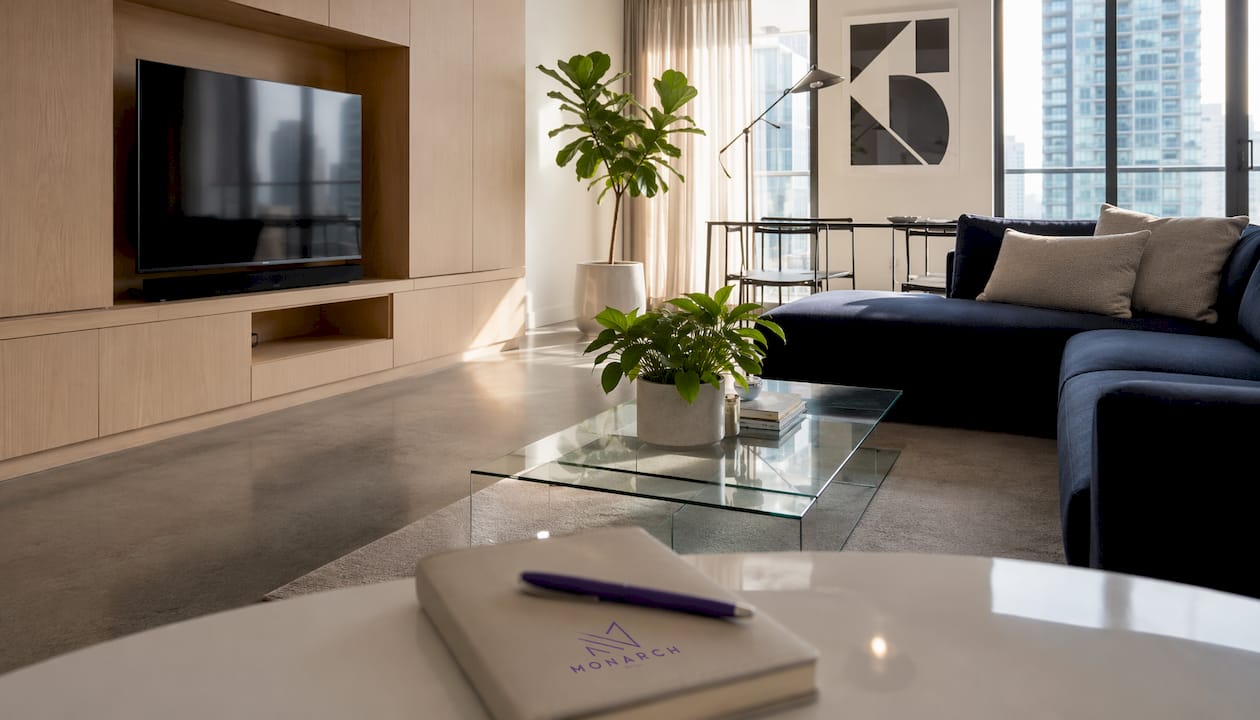
Living room media wall or library: Custom wins. Floor-to-ceiling integration, concealed cable management, and matched finishes are simply not achievable with off-the-shelf units.
Guest bedroom, kids’ room, or rental unit: Ready-made wins. Speed, low cost, and easy replacement outweigh the fit advantage here.
Monarch carpenters, a Singapore-based design and carpentry studio known for meticulous craftsmanship at modest cost, applies exactly this framework across residential and commercial projects — and the client reviews consistently reflect it.
Table of Contents
How do costs and timelines compare for custom vs ready-made?
Custom solid-wood millwork typically costs 2–5x more than comparable retail furniture upfront. That gap is real, but it narrows considerably when you factor in service life. A solid hardwood piece built with proper joinery can last many decades with normal care; a particleboard equivalent may have a significantly shorter lifespan.
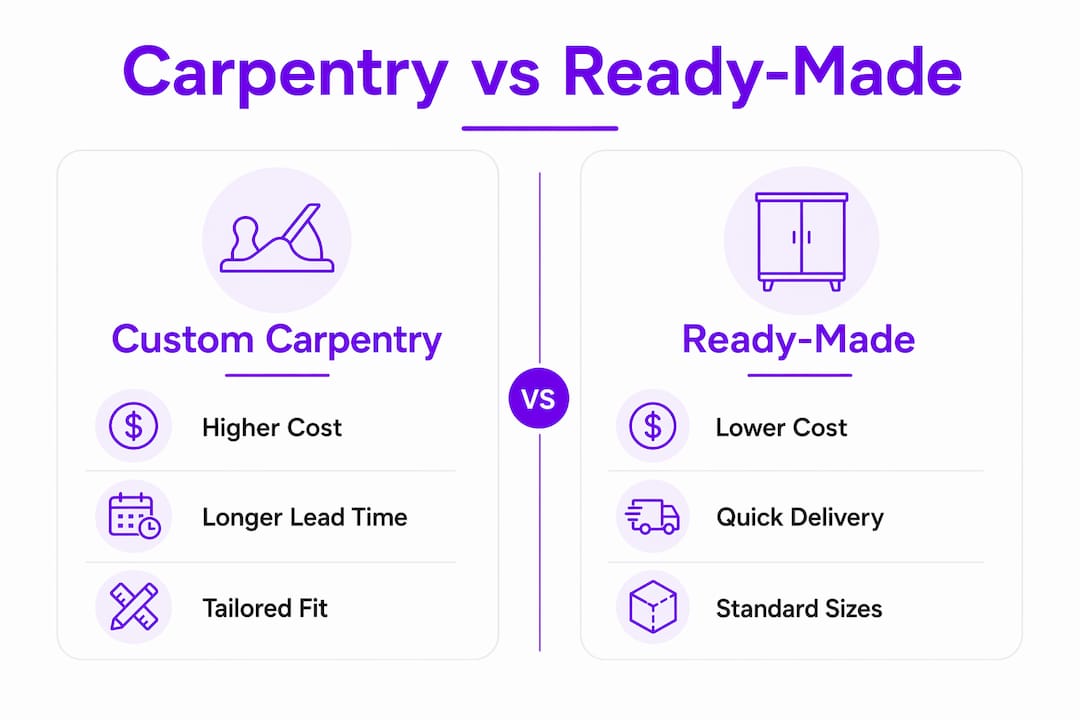
Ready-made and custom furniture price ranges and lead times vary widely depending on piece and quality, with custom typically costing 2–5x more upfront and requiring longer lead times, but offering longer expected lifespans.
A custom dining table’s cost amortized over a long lifespan may match or even beat the per-year cost of replacing cheaper retail tables multiple times, which also involves added effort and logistics. Bespoke furniture commonly runs 2–5x the upfront price yet often matches or beats lifecycle cost over 15–25 years for long-term homeowners.
One hidden cost worth flagging: professional assembly and installation for complex ready-made pieces can add meaningfully to the total bill and erode the speed advantage. Always request a full installation scope in any quote.
What actually makes custom furniture last longer?
The durability gap between custom and mass-produced furniture comes down to two things: substrate and joinery.
Solid hardwood (oak, walnut, maple): Dimensionally stable, refinishable, and repairable. A scratched oak tabletop can be sanded and re-oiled; a veneered MDF surface cannot.
Plywood core with hardwood veneer: A solid middle ground used in quality custom work. More stable than MDF, holds fasteners well, and accepts a durable finish.
Particleboard and MDF: Standard in most retail furniture. Affordable and consistent, but engineered board surfaces cannot be sanded and resurfaced, which limits long-term service life significantly.
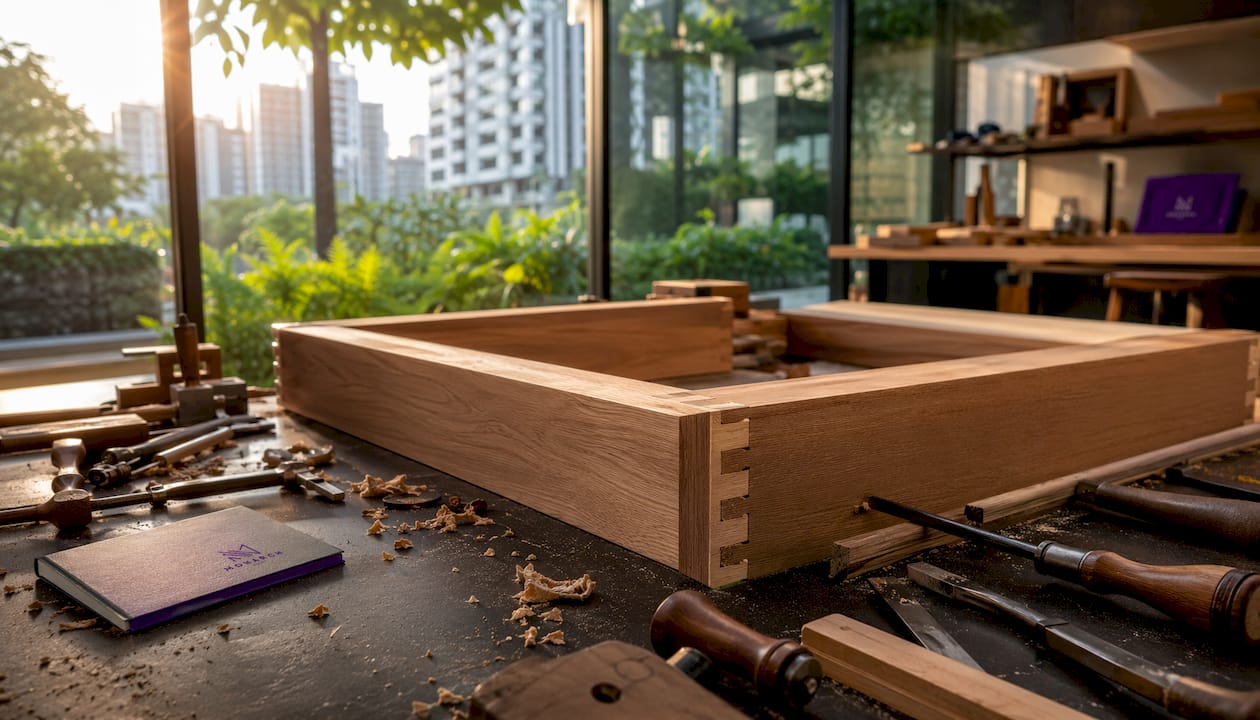
Joinery method: Dovetail and mortise-and-tenon joints — the hallmarks of quality custom work — distribute stress across a larger glue surface. Cam-lock and dowel systems used in flat-pack furniture are functional but not built for decades of daily use.
Quality furniture is identifiable by solid hardwood construction, strong joinery, consistent finish, heavy hardware, and stable drawer glides. Run your hand along the back of a drawer: if it’s raw particleboard, the piece is built to a price point, not a lifespan. Custom pieces built in solid wood with traditional joinery are, in practice, repairable indefinitely — loose joints can be re-glued, surfaces refinished, hardware replaced. Many retail pieces have near-zero secondary market value and limited refinishing options, making replacement the only realistic outcome once they show wear.
When does fit and design flexibility justify going custom?
Standard furniture is designed for standard rooms. The moment your space deviates from that assumption, ready-made starts costing you in wasted square footage, visible gaps, and visual compromise.

Custom carpentry solves fit problems in awkward spaces — attics, sloped ceilings, architectural alcoves — turning dead corners into purposeful storage. A wardrobe built to a bay window alcove can wrap the window seat, use that volume for drawers, and deliver a finished result that looks deliberate rather than patched together. A media wall that integrates storage, conceals all cable management, carries a feature panel with integrated lighting, and runs at a consistent height across an entire living room wall simply cannot be replicated with modular pieces.
Beyond fit, built-in furniture reads as architecture. Floor-to-ceiling built-ins eliminate the dust-collecting gap above freestanding wardrobes, maximize storage height, and give a room a considered quality that’s immediately perceptible. Custom also means exact material matching: the same veneer, the same hardware finish, the same profile repeated across a space. Modular pieces will always read as slightly off when the design language is specific enough to notice.
Where ready-made is genuinely adequate: standard rooms with straight walls and no structural quirks, spaces where portability matters (renters, interim homes), and secondary rooms where fit-to-space is less critical than cost and speed.
When does custom carpentry clearly win?
Some situations make the case for custom almost automatically. Recognizing them early saves both money and frustration.
High-use permanent built-ins: Kitchen cabinetry, master wardrobes, and library or media walls are used every day for decades. The role of carpentry in home design is most visible here — fit, finish, and durability compound over years of daily use.
Architectural integration: Historic homes, irregular layouts, sloped ceilings, and unique ceiling heights make standard dimensions a structural compromise. A carpenter measures the actual wall; a retailer sells to a catalog size.
Multi-functional briefs: A piece that needs to integrate lighting, conceal appliances, span structural features, and serve multiple zones almost always lands in custom territory. No off-the-shelf unit is designed for your specific combination of needs.
Long-term ownership and heirloom intent: If you’re staying in a home for 10 or more years, or building pieces intended to outlast a single generation, solid hardwood with traditional joinery is the only construction method that supports that ambition. Kitchen cabinet customization is a prime example: the right material and joinery decisions made at the outset determine whether the kitchen still looks considered in year 20.
When does ready-made furniture make more sense?
Ready-made is the rational choice more often than custom advocates tend to admit. The key is knowing which situations genuinely favor it.
Speed is the clearest advantage. Ready-made furniture can be delivered within days to two weeks of ordering, compared to 6–12 weeks for custom work. For a move, a rental, or a renovation running behind schedule, that timeline difference is decisive. A well-chosen freestanding piece does the job; a custom built-in in that context would be money better redirected elsewhere.
Children’s rooms are a strong case for ready-made. Kids’ storage and study needs change every few years, and kids’ room furniture that’s easy to reconfigure or replace keeps pace with those changes without locking in a permanent solution. Short-term rentals and staging situations follow the same logic: low cost, fast delivery, and easy replacement matter far more than fit or longevity. Renters and people who reconfigure frequently also benefit from the portability of freestanding pieces — you can take them with you, sell them, or swap them without a contractor.
How do you mix custom and ready-made for the best value?
The most practical approach for most homeowners isn’t all-custom or all-ready-made. It’s a deliberate split: custom for hero elements, ready-made for the rest.
The hero-piece rule: Identify the two or three pieces you interact with every day and that define how a room reads. Invest custom there. Use ready-made everywhere else.
Sample budget splits:
Strategy | Custom Allocation | Ready-Made Allocation | Example |
Moderate | — | — | Custom kitchen cabinets + master wardrobe; ready-made dining, study, guest room |
Premium | — | — | Custom kitchen, media wall, master wardrobe; ready-made secondary bedrooms, entryway |
Phasing custom work across projects is also worth considering. You don’t have to commission everything at once. Start with the kitchen or master wardrobe, live with the space, then add the media wall or study built-ins in a later phase. Monarch carpenters regularly works with clients on phased projects, delivering high-value hero pieces at modest cost without requiring a full-home commitment upfront.
Pro Tip: Before committing your budget, list every piece you’re furnishing and rate each one on two axes: how often you use it daily, and how long you plan to stay in the home. Anything that scores high on both is a custom candidate; everything else is a ready-made candidate.
How do you make the final decision and vet your vendors?
A structured process prevents the most common mistakes: buying a piece that almost fits, or commissioning custom work without a clear brief.
Define the need precisely. What does this piece need to do? List every function: storage type, access frequency, integration requirements, aesthetic constraints.
Measure the space accurately. Note ceiling height, wall irregularities, beam positions, and any structural features. Measure twice; order once.
Set a realistic budget with lifecycle in mind. Upfront price is only part of the calculation. Factor in expected lifespan and likely replacement cost.
Evaluate timeline against your schedule. If you need the space functional in three weeks, custom is off the table. If you have 12 weeks, it’s viable.
Decide on permanence. Are you staying five or more years? Are you a renter? Long tenure and ownership favor custom; short tenure and rentals favor ready-made.
Questions to ask a carpenter before signing:
What species and grade of wood do you use for this application?
What joinery method — dovetail, mortise-and-tenon, dowel, or cam-lock?
What is the warranty, and what does it cover?
What are your site measurement tolerances, and how do you handle discrepancies on installation day?
What is included in the installation scope — delivery, mounting, finishing, hardware?
Can I see a finish sample or mockup before production begins?
Questions to ask a retailer:
What is the substrate — solid wood, plywood, MDF, or particleboard?
Is professional assembly included, or is it an add-on cost?
What is the return and warranty policy?
Getting a detailed installation quote in writing prevents surprises. Ask for a full scope: delivery, assembly, wall mounting, and any finishing work. The bespoke commissioning process at Monarch carpenters, for example, includes a site measurement visit, finish mockup approval, and a defined installation scope before any production begins.
What about warranties, maintenance, and resale value?
Custom carpentry from a reputable studio typically carries a one-to-two-year warranty on workmanship and hardware. Solid wood construction means maintenance is straightforward: periodic oiling or waxing, re-tightening hardware, and re-gluing joints if they loosen over decades. A refinish every 10–15 years restores a solid wood surface to near-original condition.
Ready-made furniture warranties are usually 90 days to one year, covering manufacturing defects. Maintenance options are limited by the substrate: engineered board surfaces cannot be refinished, and structural repairs to cam-lock assemblies are rarely cost-effective. When a retail piece fails, replacement is usually the only practical path.
On resale value, architectural built-ins are a genuine differentiator. Buyers notice floor-to-ceiling cabinetry, integrated media walls, and custom wardrobes in a way they don’t notice freestanding furniture. Well-executed custom carpentry signals quality and permanence. Flat-pack furniture, by contrast, is typically removed or discounted before a sale.
Risk checklist for custom work:
Delays: build a two-week buffer into your project timeline.
Customization errors: approve a detailed drawing and finish sample before production.
Finish mismatches: request a physical sample against your wall color and flooring before sign-off.
Budget overruns: get a fixed-price quote that includes installation, not just fabrication.
Key Takeaways
Choosing between carpentry and ready-made furniture comes down to one principle: invest custom where permanence and daily use justify the cost, and buy ready-made where speed, flexibility, or short tenure make it the smarter call.
Point | Details |
Hero-piece rule | Prioritize custom for kitchen cabinets, master wardrobes, and media walls — the pieces you use every day. |
Lifecycle cost | Custom solid-wood pieces commonly cost 2–5x more upfront but can last 100 years, often beating lifecycle cost over 15–25 years. |
Ready-made wins on speed | Ready-made delivers in days to two weeks; custom requires 6–12 weeks minimum — timeline is often the deciding factor. |
Hybrid budget split | A deliberate custom-to-ready-made split maximizes value: custom for hero elements, ready-made for secondary spaces. |
Monarch carpenters | Monarch carpenters delivers bespoke carpentry at modest cost through a phased, design-build process suited to both full renovations and single hero-piece commissions. |
A designer’s honest take on the custom vs ready-made decision
The conventional wisdom frames this as a quality debate: custom is better, ready-made is a compromise. That framing misses the point entirely. The real question is always about fit — not just physical fit, but fit to your timeline, your tenure, and your actual daily life in the space.
What I see most often is homeowners over-investing in custom for secondary rooms they barely use, and under-investing in the kitchen or master wardrobe where they spend hours every day. The hero-piece rule exists precisely to correct that instinct. Spend where it compounds; save where it doesn’t.
The other thing people consistently underestimate is the finish mockup step. A carpenter who won’t show you a physical sample of the wood, stain, and hardware together before production begins is a carpenter whose work you’ll be living with regardless of whether it matches your vision. That one step prevents the most expensive mistakes in custom work.
Monarch carpenters approaches every project with this discipline: site measurement, finish approval, fixed-price scope, and a collaborative brief before a single piece of timber is cut. The client reviews reflect that process — not just the finished product, but the confidence that comes from knowing exactly what you’re getting before it’s built. For homeowners weighing a first custom commission, that kind of structured process at a modest cost point is where the real value lives.
Useful sources and further reading
Custom Furniture vs. Store-Bought: When the Investment Makes Sense — Timber Design + Build: lifecycle economics and material quality benchmarks.
Is Bespoke Furniture Worth It? Real Numbers — Petra Madalena: upfront vs lifecycle cost analysis for long-term homeowners.
Ready-Made vs Custom Furniture: Which Should You Choose — Kavela: the hero-piece strategy and hybrid budget allocation.
How to Tell if Furniture is High Quality — Stickley: practical quality inspection checklist.
What Determines Furniture Repair Value — WeLoveUpholstery: when repair is cost-effective vs replacement.
Bespoke Furniture Commissioning Guide for Singapore Homes — Monarch carpenters: step-by-step commissioning process and what to expect.
Kitchen Cabinet Material Options: 2026 Homeowner’s Guide — Monarch carpenters: material specs, lifespans, and finish options for cabinetry.
Monarch carpenters brings bespoke craftsmanship within reach
Most homeowners assume custom carpentry means a long wait, a large budget, and an uncertain outcome. Monarch carpenters was built to change that assumption. As a Singapore-based design and carpentry studio with an in-house team of designers and carpenters, Monarch delivers bespoke built-ins, hero-piece commissions, and full-room renovations through a fixed-price, design-build process that keeps costs modest and outcomes predictable.

The client reviews speak to something specific: not just beautiful work, but a process that felt collaborative, transparent, and worth every dollar. Whether you’re commissioning a single kitchen cabinet run or a full residential renovation, Monarch carpenters works with you from site measurement through finish approval to installation, so nothing is left to guesswork. If you’re ready to move from comparison to commission, get in touch with Monarch carpenters and start with a site consultation.
FAQ
Is custom carpentry worth the higher upfront cost?
For permanent, high-use pieces like kitchen cabinets and master wardrobes, yes. Custom solid-wood furniture can last 100 years with proper care, and its lifecycle cost often matches or beats replacing mass-produced pieces every 5–10 years.
Is carpentry a dying trade?
Demand for skilled carpenters remains strong, particularly for custom built-ins and renovation work where standard furniture cannot solve fit and integration challenges. The trade has shifted toward design-build studios rather than standalone craftsmen.
Can carpenters build any type of furniture?
Yes. Skilled carpenters build everything from kitchen cabinetry and wardrobes to dining tables, media walls, and bespoke storage. The advantage over retail is that dimensions, materials, and finishes are determined by your space and brief, not a catalog.
How do I tell if furniture is good quality before buying?
Look for solid hardwood construction, dovetail or mortise-and-tenon joinery, consistent finish, heavy hardware, and stable drawer glides. Raw particleboard on the back of a drawer is a reliable indicator of a price-point build.
What are the main types of carpentry for home furniture?
The three broad categories are finish carpentry (trim, moldings, built-ins), cabinet making (kitchen and storage cabinetry), and furniture making (freestanding custom pieces). Most residential projects combine all three, which is why a design-build studio like Monarch carpenters handles them as a single integrated scope.
Recommended
Comments