
What Is Space Planning for Singapore Homes
- Monarch

- May 30
- 9 min read
TL;DR:
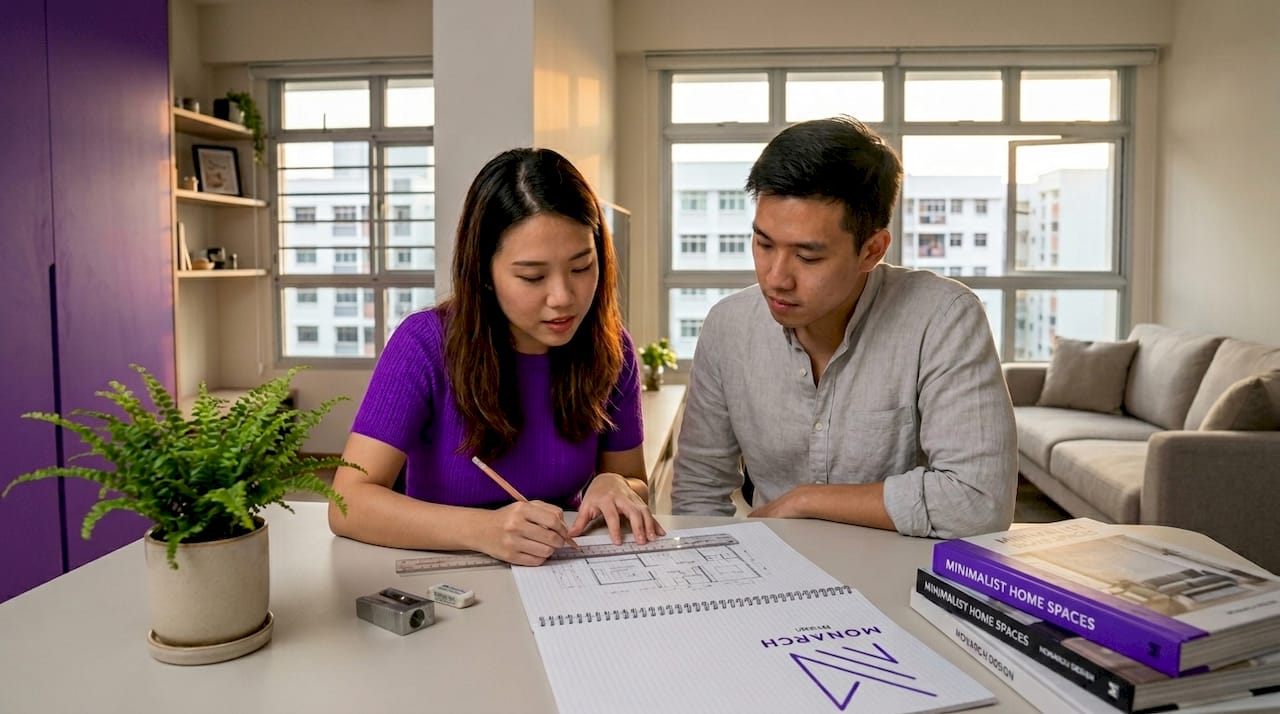
Space planning involves intentionally organizing every aspect of a home’s layout to support natural movement, routines, and comfort. In Singapore’s limited spaces, effective planning maximizes functionality through circulation, zoning, storage, and furniture choices, reducing clutter and enhancing wellbeing. Proper space planning ultimately improves daily life, property value, and avoids costly rework by prioritizing layout before style.
Most homeowners assume space planning means shifting the sofa or rearranging the dining table. It is much more than that. What is space planning, really? It is the deliberate process of organizing every square foot of your home to support how you actually live, move, and feel inside it. For Singapore homeowners and renters working with compact HDB flats, condos, or smaller apartments, getting this right is the difference between a home that feels effortless and one that always feels a little off.
Table of Contents
Key Takeaways
Point | Details |
Space planning is a system | It organizes circulation, zoning, and furniture scale together, not just furniture placement. |
Singapore homes need tailored strategies | HDB flats and condos demand specific techniques like multi-functional furniture and hidden storage. |
Early planning prevents costly rework | Treating planning as an afterthought locks in inefficiencies that are expensive to fix later. |
Visualization tools help before you commit | Bubble diagrams, sketches, and apps let you test layouts before moving a single piece of furniture. |
Good planning improves wellbeing | A well-planned space reduces clutter, congestion, and daily stress in measurable ways. |
What space planning actually means
Space planning is the formal practice of analyzing how people use a space and then organizing that space to support their needs. The industry term is spatial planning or space planning, used interchangeably across architecture and interior design. The space planning definition covers far more than furniture placement. It addresses circulation paths, zoning of activities, adjacency of related areas, ergonomic clearances, and how the layout affects daily routines.
Think of it as the skeleton beneath every good interior. Before you choose a sofa color or a light fitting, space planning determines where people will walk, where tasks will happen, and how one area connects to the next. Space planning supports people by studying movement, interaction with the environment, and how layout shapes routines.
Here are the core principles that define space planning in residential interiors:
Circulation: The paths people naturally take through a room or home. Good planning keeps these clear and logical.
Zoning: Grouping related activities together, such as separating a study nook from the living area in a one-bedroom condo.
Adjacency: Placing spaces that relate to each other close together, like the kitchen and dining area for practical meal flow.
Ergonomics: Sizing and positioning furniture so that daily tasks feel physically comfortable and natural.
Scale and proportion: Matching furniture size to room dimensions so nothing overwhelms or underwhelms the space.
The distinction between residential and commercial space planning is worth noting. Commercial planning often prioritizes code compliance, safety egress, and occupancy loads. Residential planning centers on lifestyle fit, emotional comfort, and personal routine. Both share the same underlying logic. Facility space planning establishes organization by occupancy, clearance, and safety needs, and those same principles translate directly into making your home genuinely livable.
Common mistakes in home space planning
The most frequent mistake is treating space planning as a finishing step rather than a starting one. People choose furniture first, then try to make it work in the room. The result is a layout that was never designed around how they actually move and live.
Here are the pitfalls that cause the most friction in Singapore homes:
Ignoring circulation paths: Placing a console table or extra chair in a natural walkway creates daily annoyance that builds over time.
Wrong furniture scale: Oversized sofas in a small HDB living room shrink the perceived space and block light. Undersized pieces in a larger condo make the room feel unfinished and disconnected.
No zoning in open-plan layouts: Without clear zones, open-plan spaces feel chaotic. A work-from-home desk placed in the middle of the living area blurs the boundary between work and rest.
Neglecting storage planning: Underestimating storage needs leads to clutter, which reduces circulation and comfort across the entire home.
Forgetting multi-functional zones: In compact apartments, every area needs to serve more than one purpose. A dining table that cannot double as a work surface is a missed opportunity.
The deeper problem with poor spatial decisions is that they lock in friction. Bad space planning creates bottlenecks, noise conflicts, and underused rooms that affect your daily life in ways you may not immediately trace back to the layout.
Pro Tip: Before moving any furniture, walk through your home and map where you naturally pause, turn, or feel blocked. These friction points are your starting guide for what needs to change.
Space planning techniques for Singapore homes
Applying space planning strategies in a Singapore context means working with real constraints: narrow corridors, limited natural light from certain angles, open-plan HDB living and dining areas, and rooms that often need to serve multiple purposes. Here is a practical, step-by-step approach to applying space planning techniques in these conditions.
Measure everything first. Get the exact dimensions of every room, including door swings, window positions, and column locations. This is the foundation before any planning can begin.
Define your activity zones. Write down every activity that happens in each room. A bedroom might need zones for sleeping, dressing, and working from home. A living room might need zones for relaxing, entertaining, and storing media.
Plan circulation paths. Mark the natural walkways between zones and between rooms. Aim for at least 90 centimeters of clear walking space in primary paths and 60 centimeters in secondary paths.
Choose furniture to fit the zone, not the other way around. This is where compact kitchen layouts and built-in storage solutions make a measurable difference. A piece of furniture that serves two functions is worth twice the floor space it occupies.
Consider natural light and ventilation. In Singapore’s climate, airflow through a space matters. Avoid blocking windows or air conditioning units with tall furniture. Position seating to benefit from natural light without creating glare on screens.
Iterate before you commit. Use tape on the floor to mark furniture positions before purchasing or moving anything. This low-cost step saves significant rework.
Pro Tip: In HDB flats, the corridor between the bedroom and kitchen is often the narrowest and most trafficked path. Clearing even 15 centimeters from that path by reconfiguring a storage unit nearby can transform how the entire home feels to live in.
Good spatial design creates clarity, order, and flow, turning underused corners into purposeful spaces that support your lifestyle rather than fight it.
Tools to visualize your floor plan
Knowing the theory of space planning is one thing. Seeing it mapped out is another entirely. The good news is that you do not need to be an architect to visualize your layout before committing to changes.
Tool | Best For | Skill Level |
Graph paper sketch | Quick room layout tests, measuring and scaling by hand | Beginner |
Bubble diagrams | Mapping spatial relationships and zone adjacency | Beginner |
RoomSketcher or Planner 5D | Digital floor plan creation with furniture placement | Intermediate |
AutoCAD or SketchUp | Detailed technical drawings for renovation planning | Advanced |
Tape-on-floor method | Physical visualization of furniture footprints before purchase | Beginner |
Bubble diagrams deserve more attention than they typically receive. Rooms and connections modeled as nodes and edges let you analyze circulation patterns systematically without needing any software. You simply draw circles for each room or zone and connect them with lines showing how people move between them. Where connections overlap or cluster awkwardly, you have found a circulation problem worth solving before finalizing a layout.
Digital apps like RoomSketcher work well for Singapore apartments because you can input exact dimensions and drag-and-drop furniture to scale. This removes the guesswork from questions like “will a 200 cm sofa leave enough room for the TV console?” before you spend anything.
Professional input adds a layer that tools cannot fully replace. A trained interior designer reads a floor plan differently, spotting adjacency issues or ventilation conflicts that a homeowner might miss. For a renovation or significant refurnishing, combining your own floor plan sketches with a professional review is the most practical approach. A renovation planning checklist can help you document your requirements clearly before any consultation.
Real benefits of good space planning
The importance of space planning becomes most obvious when you live in a well-planned home versus one that was not. The benefits are not abstract.
A thoughtfully planned interior reduces daily friction. You stop bumping into the corner of the coffee table. The morning routine flows because the wardrobe, bathroom, and kitchen connect in a logical sequence. You find yourself spending more time in rooms that previously felt unused because they now have a clear purpose.
“Space planning impacts how people, tasks, and systems work together, choreographing movement and confirming safety while focusing on the human experience, including daylight and acoustics.” Space planning in architecture
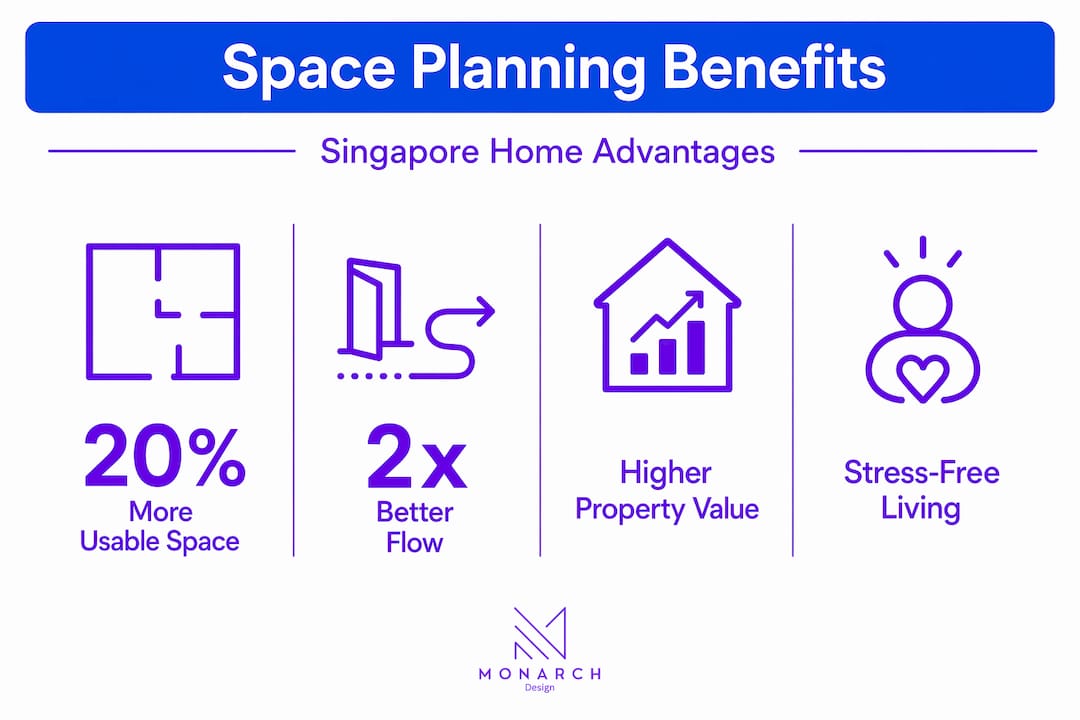
For Singapore residents living in smaller footprints, the benefits of space planning extend to property value. A well-planned interior photographs better, feels more spacious during viewings, and appeals to a wider range of buyers or tenants. Clutter is reduced not by owning less, but by designing storage into the plan from the start. Stress follows. Homes that are organized spatially feel calmer to live in, which has a genuine effect on daily wellbeing.
My take on space planning for Singapore homes
I’ve seen hundreds of Singapore homes that look polished in photos but feel exhausting to live in. The problem is almost always spatial, not stylistic. Homeowners invest in beautiful finishes but skip the foundational work of planning how people will actually move through the space.
What I’ve learned from working on these interiors is that the most impactful changes are rarely the most expensive ones. Shifting a partition, rerouting a circulation path, or replacing one large piece of furniture with two smaller multi-functional ones can transform a home more effectively than a full renovation. But you only find those solutions through disciplined spatial thinking, not through browsing furniture catalogs.
I’ve also seen what happens when planning is treated as an afterthought. Clients who skip the planning phase and jump straight to purchasing end up with rooms full of furniture that doesn’t work together, and the fix always costs more than the original planning would have. The uncomfortable truth is that one hour spent with a tape measure, graph paper, and a clear brief about how you live will do more for your home than ten hours of shopping.
If I could give one piece of advice to every Singapore homeowner starting a renovation or refurnishing project, it would be this: plan the space before you plan the style. Aesthetics are easier to layer on once the spatial logic is sound.
— Seth Wayne
Transform your space with Monarch carpenters

If this has helped you think differently about how your home is organized, the next step is getting expert eyes on your specific floor plan. Monarch carpenters is a Singapore-based design and carpentry studio known for delivering thoughtful, personalized interior solutions that balance beautiful design with practical spatial planning. Clients consistently highlight the quality of the design work alongside honest, modest pricing. Whether you are working with a compact HDB flat or a larger condo, the team brings genuine technical expertise and a collaborative approach that turns your brief into a space that actually works for your life. Explore more ideas and design thinking on the Monarch carpenters blog.
FAQ
What is space planning in simple terms?
Space planning is the process of organizing a room or home to support how people move through it and use it daily, covering zones, circulation paths, furniture scale, and storage.
Why is space planning important for small Singapore apartments?
In compact HDB flats and condos, poor spatial planning creates bottlenecks and wasted areas, while good planning maximizes every square foot for comfort, function, and daily ease.
How do I create a basic floor plan for my home?
Measure your room dimensions accurately, sketch the layout on graph paper or use a free app like RoomSketcher, then map your activity zones and circulation paths before placing any furniture.
What is the difference between space planning and interior design?
Space planning focuses on how a space functions and flows, while interior design covers the aesthetic layer including colors, materials, and finishes that sit on top of a sound spatial plan.
Can I do space planning myself or do I need a professional?
You can handle the basics yourself using bubble diagrams, scaled sketches, and floor plan apps, but a professional designer adds value by identifying circulation conflicts and spatial inefficiencies that are easy to miss without trained experience.
Recommended
Comments